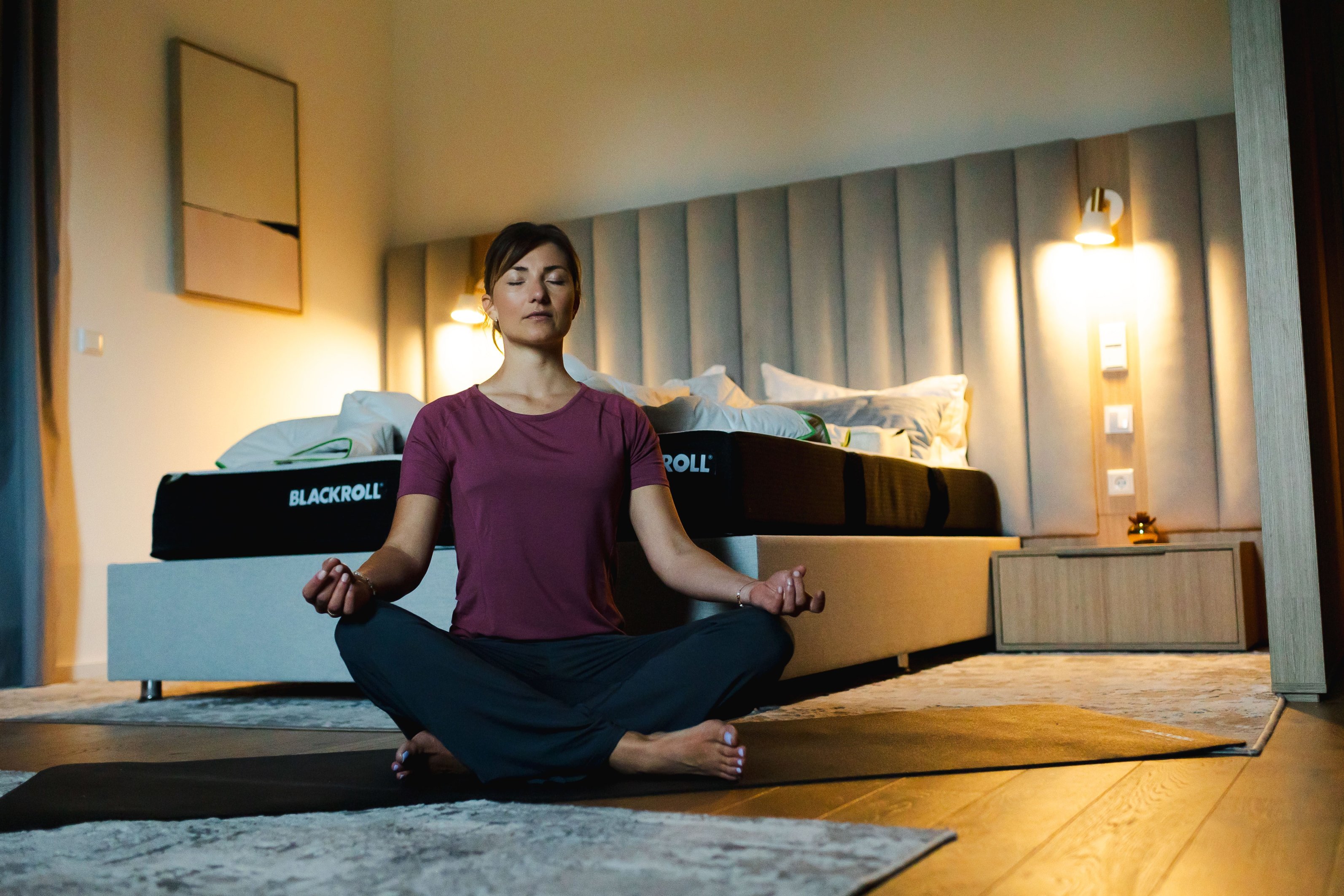
Wind-down: your transition ritual from day to evening

A wind-down is very similar to a classic evening or bedtime ritual. It describes the conscious transition between activity and recovery. With simple habits such as a walk, breathing exercises or stretching, you give your body and nervous system time to shift down a gear – and lay the foundation for real recovery and good sleep. We explain the benefits, show typical pitfalls and offer inspiration for your own transition ritual after work – with no pressure at all.
Key takeaways:
- A wind-down is a transition ritual from the active day into the rest phase.
- Switching off often works in three steps: consciously finish your activity, reduce stimuli, practise a relaxation ritual.
- Routines such as reading, breathing exercises, stretching or journaling help you to settle into your evening.
- 20 to 30 minutes are usually enough for a wind-down – to let go of the day and start the evening and night more relaxed.

Was bedeutet “Wind-Down”?
A wind-down is the conscious transition from the active day into the rest phase, or the end of the working day. It does not mean the complete evening routine or bedtime ritual, but the roughly 20 to 30 minutes in which you gradually shift down a gear, physically and mentally. Importantly, you are not investing ‘extra’ time or adding another appointment – you are simply shaping your time so that it genuinely does you and your recovery good.
The term comes from English and means something like ‘to slow down’ or ‘to let something fade out’. That is exactly the idea: after work, sport or other activities, your body gets the chance to switch from activity mode into a calmer state .
Even small wind-down rituals – for example stretching, a breathing exercise or dimming the lights – can help to mark the transition from day to evening.
A wind-down is usually not about getting tired or falling asleep as quickly as possible. Instead, you prepare your body and nervous system to let go of the tension of the day. This transition is considered an important part of healthy sleep regulation (Meneo et al., 2025). This evening calm can feel unfamiliar at first. See it as an experiment: use the time to find out what does you good and how you can bring more recovery phases back into your everyday life.
Wind-down ≠ evening routine
An evening routine usually means a fixed sequence of habits that you carry out every day before bed, in the same or a similar order. A wind-down, on the other hand, marks the conscious transition from the active day into calm evening mode. The aim is to consciously slow body and mind down. Your wind-down can therefore be part of your evening routine.


Why switching off in the evening matters
Our body does not switch from work mode to rest mode at the touch of a button. After an intense day of meetings, sport or lots of stimuli, the nervous system needs time to wind down. This is exactly where a conscious wind-down helps: it makes the transition from activity to recovery easier and so indirectly supports natural sleep regulation (Meneo et al., 2025).
Your nervous system needs a transition
Calming down is not just a physical process – the mind needs to slow down too. In the evening our thoughts often race – experts speak of mental hyperarousal before sleep. A wind-down gives not only the body but also the mind time to let go of the day (Meneo et al., 2025).
During the day, the sympathetic nervous system often dominates. This is the part of the nervous system that gets the body ready to perform. For recovery to be possible, the parasympathetic nervous system then has to become more active. This ‘rest nerve’ helps, among other things, to lower heart rate and blood pressure, to calm and deepen breathing and to stimulate digestion.
A wind-down can support this switch. Studies show that relaxation techniques such as breathing exercises, meditation or progressive muscle relaxation are associated with higher heart rate variability (HRV). A higher HRV is seen as a sign that the body can switch more flexibly between tension and relaxation (Parker et al., 2020).
Recovery does not start in bed
Many people only try to switch off once they are already lying in bed. In fact, recovery begins during the day. If you go to bed with an overstimulated nervous system, you will not get your body into rest mode within a short time. And this is where the foundation for recovery during the night is laid.
Researchers describe the wind-down as a natural part of sleep regulation: certain behaviours long before bedtime help to gradually reduce physical and mental activation – without the conscious aim of having to fall asleep immediately (Meneo et al., 2025).
Such relaxation phases are associated with, among other things, better heart health, less muscle tension, lower perceived stress and positive effects on concentration, memory and mental wellbeing (Parker et al., 2020; Laborde et al., 2022; Calderone et al., 2025).
Why a wind-down makes sense
A conscious transition ritual helps your body to switch from activity mode into recovery.
Possible benefits of a regular wind-down include:
- easier switching off after a stressful day
- support for parasympathetic activation
- less physical and mental tension
- better heart health
- improved concentration
- lower perceived stress
- better conditions for a natural transition into sleep


No-gos beim Runterschalten am Feierabend
Not everything that feels relaxing in the evening actually helps your body to wind down. Some habits keep the nervous system in activity mode for longer or worsen sleep quality – even if you feel tired at first (Meneo et al., 2024). Here are some typical after-work routines that tend to get in the way of your recovery:
Endless scrolling or streaming series
For many people, winding down is linked to screen time. Scrolling through social media or watching an episode of your favourite series often turns into much more time than planned – and that has consequences.
Recent studies show a clear link between evening screen time and poorer sleep. Each additional hour of screen use was associated with a 59% higher risk of insomnia symptoms and an average of 24 minutes less sleep (Hjetland et al., 2025). Another study also found links between screen use before bed, poorer sleep quality and shorter sleep duration (Zhong et al., 2025; Calderone et al., 2025). What we consume is particularly important here.
For your wind-down, this means: limit screen time consciously where possible and do not start your evening on your smartphone or laptop.
Intense workouts in the evening
Exercise is generally a good thing. However, very intense training sessions in the evening can keep the body in activity mode for longer.
A study of more than 14,500 people and over four million recorded nights by Leota et al. (2025) shows that late, intense exertion was associated with later sleep onset, shorter sleep duration, a higher heart rate at night and a lower HRV. The raised core body temperature plays a particular role here.
If you want to keep training as part of your wind-down ritual, you should therefore finish intense sessions at least four hours before bedtime if possible, or opt for gentle movement such as mobility work or stretching.

Working late with no end in sight
If the working day extends, mentally or in reality, well into the evening, switching off becomes all the more difficult.
Shift and night work in particular throw the body clock out of balance. A meta-analysis by Veruscka Leso et al. (2021) shows that a permanently shifted daily rhythm can impair attention, memory and cognitive performance and is associated with long-term health risks.
That is why it is worth creating a transition ritual to consciously end the working day – mentally too. This gives the body stability, even with a changing rhythm.
Late snacking to wind down
Eating, especially snacking on the sofa in the evening, is a tried-and-tested way to wind down. But often the opposite happens: the body is put to work just when it wants to switch into rest mode.
A study by Iao et al. (2021) shows that late meals – especially within the last one to three hours before bedtime – can change sleep architecture. Deep sleep and REM sleep decrease, while sleep becomes lighter and more restless. In other words, snacking is probably not your best choice for regulating your nervous system.

Alcohol to relax
A glass of wine or beer after work? It sounds like a solid wind-down programme, but it is anything but restful for the body.
It has now been shown that alcohol can shorten the time it takes to fall asleep, but it also increases the likelihood of waking during the night, reduces REM sleep and worsens sleep quality – especially in the second half of the night (Chaput et al., 2026). So reach for a glass of water or a cup of tea instead to switch into rest mode.

These habits make it harder to switch off
- For a successful wind-down, try to avoid:
- long periods of scrolling or streaming
- intense exercise in the last few hours before bed
- working late into the evening
- heavy meals or snacking
- alcohol as a supposed relaxation aid


Übergangsritual gestalten in 3 Schritten
20 to 30 minutes are often enough to consciously shape the transition from the active day into the calm evening. Here is what a wind-down can look like:
1. Mentally close the working day
Take five minutes – ideally set a timer – and write down everything that is still on your mind: open tasks, appointments or thoughts. This so-called ‘brain dump’ helps many people to let go mentally, because nothing needs to be held in the mind any more (Scullin et al., 2018).
Working from home? Then we recommend a small closing ritual, such as deliberately closing your laptop, tidying your desk or shutting the study door. This signals to yourself: the working day is over.
2. Consciously reduce stimuli
Now the actual transition begins. Put your smartphone, laptop and tablet aside where possible and dim the lights at home. This helps your body to gradually switch into rest mode. Focus instead on what really does you good.
By the way, less light can not only have a calming effect but also supports your melatonin, which rises naturally in the evening and prepares your body for rest.
3. Wind down with a regular ritual
To finish, choose a calm activity that you enjoy. This could be, for example, a warm shower, a few minutes of stretching, breathing exercises or a few pages of a book. The transition ritual should not feel like optimisation, but like genuine relaxation. You will find ideas in the next section.
The more often you repeat your individual wind-down routine, the easier it will become, physically and mentally, to switch from activity to recovery mode. Over time, your body learns these sequences and automatically associates them with calm.
A tip to make it a habit: link your wind-down to something you do every evening anyway – for example after dinner or when the children are in bed. That way, the fixed anchor becomes the starting signal.


10 relaxation rituals for a calm evening
A good wind-down does not have to be perfectly planned. What matters is that the transition helps you to consciously leave the working day behind and slowly switch into rest mode.
Which ritual suits you is individual and also depends on your day: after a lot of mental work, something physical often does you good (e.g. a walk or stretching), after physical exertion something calmer (e.g. breathing exercises or reading), and if your thoughts are racing, many people find journaling helps. Try out what feels right for you.
Here are a few ideas:
#1 A good book instead of your smartphone
- For many people, reading is an ideal transition between work and free time. Unlike scrolling, a book exposes you to fewer new stimuli and lets you concentrate on just one thing. Even 15 to 30 minutes can help you to gain distance from the day.
#2 Get creative
- Knitting, painting, drawing, pottery or other creative hobbies can help to shift your focus from everyday life to the moment. Many people experience a so-called flow state: thoughts become calmer while the hands stay busy. Perfect for letting the working day fade out consciously.
#3 Consciously wind down with breathing exercises
- Breathing is one of the simplest ways to calm the nervous system. Even a few minutes of conscious breathing can help to release inner restlessness and begin the transition into the evening. Slow breathing techniques with a longer exhale are particularly suitable. Discover our breathing exercises for calming down and falling asleep.
#4 Write down your thoughts
- If you still have lots of thoughts going through your head in the evening, journaling can help. Write down what went well today, what is on your mind or what is coming up tomorrow. That way, to-dos and worries do not have to keep running around your head. Even five minutes are often enough to calm down inside and gain clarity.
#5 Gentle stretching
- Light stretching exercises can help to release tension after sitting for a long time or after a tiring day. Unlike an intense workout, the focus here is on mobility and conscious awareness of the body. Even a few minutes are often enough to gradually tune the body in to the rest phase. Looking for inspiration? Try our full-body stretching exercises for a calm evening.
#6 Yoga to close the day
- A calm yoga flow combines movement, breathing and mindfulness. Unlike many other sports, it is not about performance, but about bringing body and mind into balance. Particularly gentle sessions such as fascia yoga are well suited as a transition ritual.
#7 A warm shower or a wellness ritual
- A warm shower, a bath or a short skincare routine can signal to the body that the active part of the day is over. Take time for it on purpose and avoid rushing. It is often precisely these small rituals that make the transition into the evening easier. The warmth can also help your nervous system to reach rest mode more quickly, as your body temperature drops slightly after showering.
#8 A walk in the fresh air
- A short walk after work helps many people to separate work and free time mentally – especially if you work from home. At the same time, exercise in the fresh air offers a change of perspective and creates distance from the screen. Even 15 to 20 minutes can be enough. Try to consciously notice your surroundings, as this brings your attention into the moment and helps you to switch off. Find out more about the positive effects of daily walks here.
#9 Move first, then wind down
- After a long day at the office, many people benefit from some movement first, before the actual relaxation begins. A short after-office workout can help to release tension and clear your head. Switching off often becomes easier afterwards.
#10 Foam rolling to end the day
- A foam roller or a fascia ball can help to loosen tense muscles after sitting for a long time or after sport. Use slow, calm movements and consciously focus on your breathing. That way, fascia massage relaxes not only the body but also the mind. For your own wind-down ritual, try our evening routine with the foam roller, for example.
Your routine for a good wind-down



Ending the day with children
With children, the evening is often livelier than planned: relaxation? Not a chance! That makes fixed transition rituals all the more important. Harvard author Heather Miller (2018) confirms that predictable routines give children security and orientation. At the same time, they promote skills such as concentration, self-regulation and independence. Tip: let your children help shape the ritual so that it fits your family life.
A wind-down with the whole family often takes a little more creativity, but does not have to be complicated. You will find ideas for a relaxed evening with children here: Evening routine for children – relaxed rituals for the whole family.
Conclusion: gliding from the active day into the rest phase
A wind-down creates a conscious transition between activity and recovery – exactly the phase that often falls by the wayside in a hectic everyday life. Instead of staying in work or leisure mode until late at night, you activate the parasympathetic nervous system and signal to body and mind to slowly wind down.
It is not about the perfect routine. Whether breathing exercises, a walk, stretching, reading or a warm shower – what matters is that your transition ritual happens regularly and feels good to you personally.
Especially after a demanding working day, lots of appointments and a flood of information, a conscious wind-down routine is recommended: consciously finish your activity, reduce stimuli, shape a relaxation ritual – it is that simple! Just 20 to 30 minutes of transition ritual can help you to let go of tension, cope better with stress in the long term, sleep restfully and generally stay more rested and productive.


For top sleep quality
Recovery PillowFAQs about the wind-down transition ritual
If your mind keeps working after the end of the working day, an abrupt switch-off often does not help – a conscious transition does. Small rituals such as a walk, journaling, breathing exercises or gentle stretching can help you to gain distance from the day. What matters is that you regularly take time to wind down, rather than going straight from the desk to the sofa or to bed.
A wind-down is a conscious transition ritual between the active day and the rest phase. It is not directly about falling asleep, but about slowly winding body and mind down and consciously closing the day.
Our nervous system does not switch from activity to recovery at the touch of a button. A wind-down supports the parasympathetic nervous system – the part of the nervous system responsible for relaxation and recovery. This makes it easier for many people to let go of stress and start the evening feeling relaxed.
There are many ways to consciously let the day fade out. Popular options include reading, journaling, breathing exercises, stretching, yoga, a warm shower, a walk or a fascia massage. What matters is that the ritual feels good to you and happens regularly. You should preferably avoid screen time during this transition period.
20 to 30 minutes are often enough to tune body and mind in to the evening. Regularity matters much more than duration. A recurring transition ritual helps your body to switch more easily from activity mode into recovery mode.
After a long working day, many people benefit from some movement first. A gentle after-office workout can help to release tension and clear your head. Calmer activity then makes sense, such as stretching, a shower or breathing exercises. It is precisely this combination of movement followed by relaxation that makes the transition from performance mode to recovery mode easier for many people.
Further reading







All exercises in our App
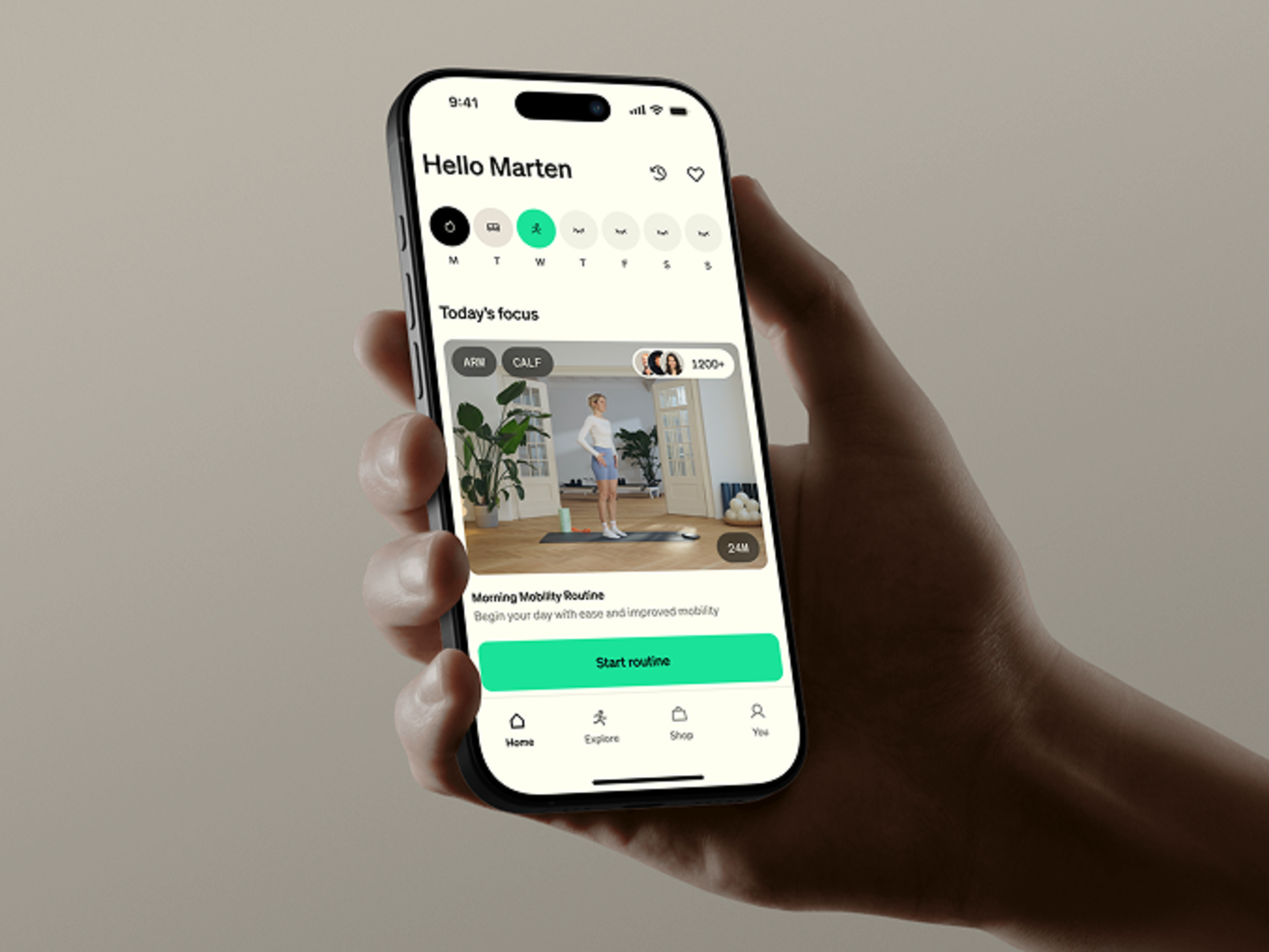
Download our free app to find more than 500 exercises and configure your own workouts, track your trainings and progress. Save your favorite routines and exercises and learn how to recover, train your flexibility and strength as well as your athletic capabilities.
Quellen:
Calderone, A., Marafioti, G., Latella, D., Corallo, F., D'Aleo, P., Quartarone, A., Calabrò, R. S. (2025). Effectiveness of relaxation techniques for stress management and quality of life improvement in cardiovascular disease and hypertensive patients: a systematic review. Psychology, Health & Medicine, 30(7), 1281–1352. https://pubmed.ncbi.nlm.nih.gov/39915922/
Chaput, J. P. (2026). Alcohol, Wine, and Sleep in Adults: Insights from a Narrative Review. Nutrients, 18(4), 585. https://pmc.ncbi.nlm.nih.gov/articles/PMC12942847/
Hjetland, G. J., Skogen, J. C., Hysing, M., Gradisar, M., & Sivertsen, B. (2025). How and when screens are used: comparing different screen activities and sleep in Norwegian university students. Frontiers in Psychiatry, 16, 1548273. https://www.frontiersin.org/journals/psychiatry/articles/10.3389/fpsyt.2025.1548273/full
Iao, S. I., Jansen, E., Shedden, K., O'Brien, L. M., Chervin, R. D., Knutson, K. L., & Dunietz, G. L. (2021). Associations between bedtime eating or drinking, sleep duration and wake after sleep onset: Findings from the American Time Use Survey. British Journal of Nutrition, 127(12), 1888–1897. https://pmc.ncbi.nlm.nih.gov/articles/PMC9092657/
Laborde, S., Allen, M. S., Borges, U., Dosseville, F., Hosang, T. J., Iskra, M., Mosley, E., Salvotti, C., Spolverato, L., Zammit, N., & Javelle, F. (2022). Effects of voluntary slow breathing on heart rate and heart rate variability: A systematic review and a meta-analysis. Neuroscience & Biobehavioral Reviews, 138, 104711. https://doi.org/10.1016/j.neubiorev.2022.104711
Leota, J., David, M. P., Le, F., Czeisler, M. C., Mascaro, L., Capodilupo, E. R., Wiley, J. F., Drummond, S. P. A., Rajaratnam, S., & Facer-Childs, E. R. (2025). Dose-response relationship between evening exercise and sleep. Nature Communications, 16, 3297. https://doi.org/10.1038/s41467-025-58271-x
Leso, V., Fontana, L., Caturano, A., Vetrani, I., Fedele, M., & Iavicoli, I. (2021). Impact of Shift Work and Long Working Hours on Worker Cognitive Functions: Current Evidence and Future Research Needs. International Journal of Environmental Research and Public Health, 18(12), 6540. https://pmc.ncbi.nlm.nih.gov/articles/PMC8296479/
Meneo, D., Curati, S., Russo, P. M., Martoni, M., Gelfo, F., & Baglioni, C. A. (2024). A Comprehensive Assessment of Bedtime Routines and Strategies to Aid Sleep Onset in College Students: A Web-Based Survey. Clocks & Sleep, 6(3), 468–487. https://pmc.ncbi.nlm.nih.gov/articles/PMC11417809/
Meneo, D., & Baglioni, C. (2025). Winding down for sleep: How behavioral, cognitive, motivational, and emotional factors interact to influence sleep regulation and health. Sleep Medicine Reviews, 83, 102154. https://doi.org/10.1016/j.smrv.2025.102154
Miller, H. (2018). The Power of Evening Routines. Harvard Graduate School of Education. https://www.gse.harvard.edu/ideas/usable-knowledge/18/10/power-evening-routines
Parker, S. L., Sonnentag, S., Jimmieson, N. L., & Newton, C. J. (2020). Relaxation during the evening and next-morning energy: The role of hassles, uplifts, and heart rate variability during work. Journal of Occupational Health Psychology, 25(2), 83–98. https://doi.org/10.1037/ocp0000155
Scullin, M. K., Krueger, M. L., Ballard, H. K., Pruett, N., & Bliwise, D. L. (2018). The effects of bedtime writing on difficulty falling asleep: A polysomnographic study comparing to-do lists and completed activity lists. Journal of Experimental Psychology: General, 147(1), 139–146. https://pubmed.ncbi.nlm.nih.gov/29058942/
Zhong, C., Masters, M., Donzella, S. M., Diver, W. R., & Patel, A. V. (2025). Electronic Screen Use and Sleep Duration and Timing in Adults. JAMA Network Open, 8(3), e252493. https://jamanetwork.com/journals/jamanetworkopen/fullarticle/2831993