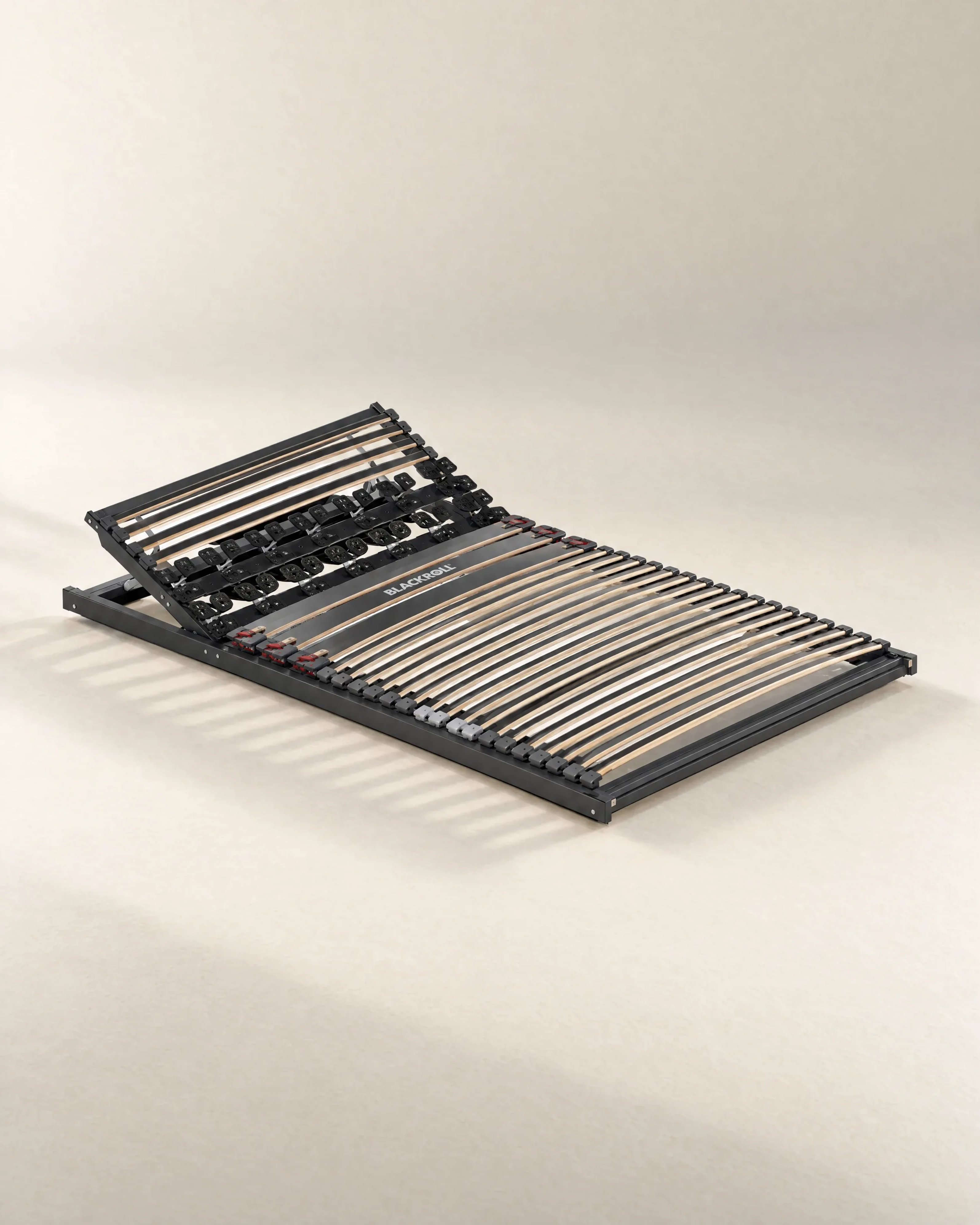
Adjusting a slatted bed base: step by step by sleeping position
How you adjust your slatted bed base depends mainly on your sleeping position and your body weight. The firmness sliders in the middle third determine how far your pelvis and lower back sink in. The aim is a spine that is as neutral as possible: side sleepers need room for the shoulder, while back and stomach sleepers need more support in the middle of the body. Adjusting the slatted bed base does not replace an unsuitable mattress.
Key takeaways
- The firmness sliders sit in the middle third and only change how deeply you sink in around the pelvis and lower back – the rest of the base stays largely the same.
- The aim is a spine that is as neutral as possible: side sleepers let the shoulder and hip sink in, back sleepers support the lower back, and front sleepers avoid sagging in the middle.
- According to the research, medium-firm, individually adjustable sleeping surfaces tend to be more favourable than very firm ones for non-specific back pain. (Kovacs et al., 2003; Radwan et al., 2015; Caggiari, 2021)
- The sliders can only correct so much: they can’t make up for an unsuitable mattress. The slatted base and mattress always work together.
- After every change, the rule is: lie down to test it, try it for a few nights, then fine-tune.


What is the slatted base adjustment for?
A slatted base doesn’t just carry the mattress – it also changes how the mattress supports you. The setting determines how deeply individual areas of your body sink in and whether your spine stays straight as a result.
While you sleep, your spine should keep its natural double S shape: a slight curve in the neck, a gentle rounding in the chest area and a fine curve in the lower back. If this alignment tips – for example because the pelvis sags too far – it may put strain on the lower back. Studies on sleeping surfaces suggest that a more neutral alignment is associated with less back discomfort at night and more comfort. (Kovacs et al., 2003; Leilnahari et al., 2011)
Think of the mattress and slatted base together
The slatted base and mattress are a system, not a single component. A soft foam mattress responds differently to the springing than a firm pocket-sprung one. So whenever you change something on the slatted base, you shift how the two layers work together – the same slider position can feel different on two beds.

Understanding the parts: zones, firmness sliders, middle zone
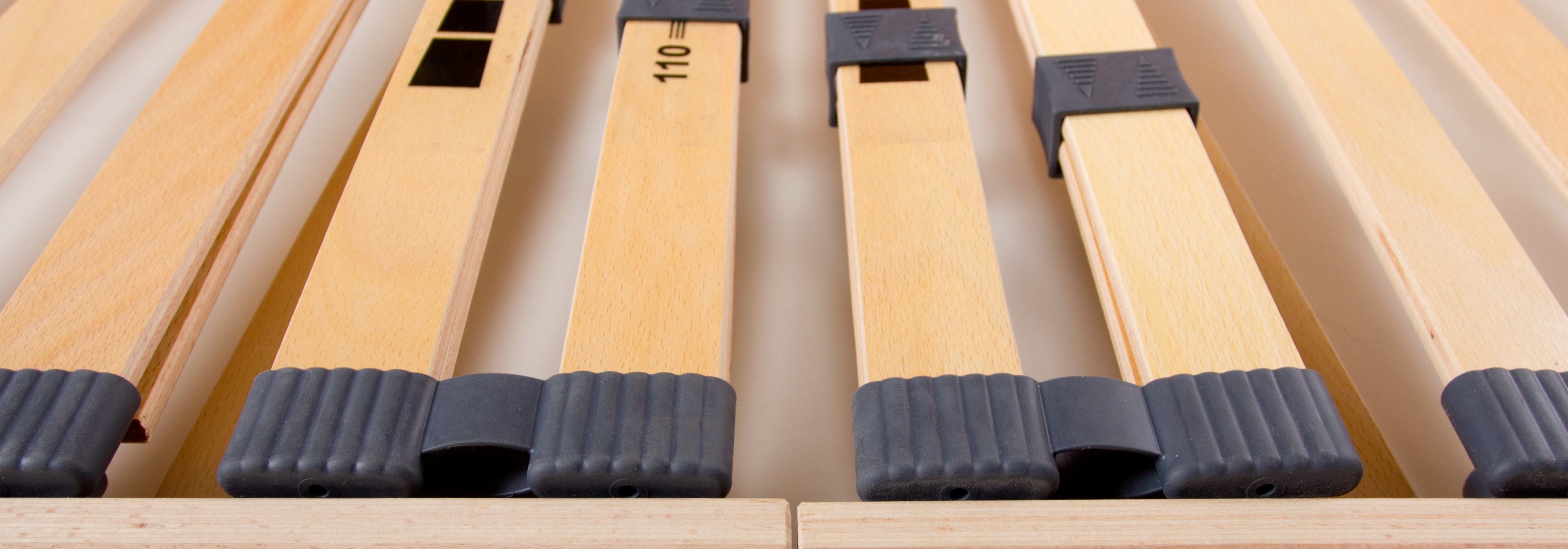
Most of the effect comes from the middle zone – where your pelvis and lower back rest. This is exactly where most bases have the sliders that let you make the zone firmer or softer.
So that you know what you’re actually changing, here are the key terms and how they feel in practice:
Term | What it means for you | When it matters | Typical pitfalls |
|---|---|---|---|
Middle zone/sliders | Firmer or softer in the pelvis and lower back area | Higher body weight, back sleepers | Adjusted in the wrong direction – the direction depends on the design |
Shoulder zone | Shoulder is allowed to sink in | Side sleepers, broad shoulders | Too firm = pressure on the shoulder |
Slat spacing | Support and ventilation | Foam mattresses | Too wide = mattress sags |
Adjustable/motorised | Head and foot sections can be tilted | Reading, getting up, care | The extra cost is not worthwhile for everyone |
What the sliders really do – and their limits
What the sliders can’t do:
- They don’t make a sagging or overly firm mattress suitable again, they don’t replace the correct mattress size and they don’t make up for an unsuitable sleeping position.
What they can do:
- fine-tune the give in the middle third. Which way you need to push them depends on the design – this is where mistakes are made most often. Two types are common:
T-sliders: a mushroom-shaped knob with a narrow neck that sits on top of a single slat. Pushed towards the centre, the zone becomes firmer; pushed outwards, it becomes softer.
O-sliders: a ring- or clip-shaped block that surrounds the slat. Here it’s exactly the other way round – towards the inside it becomes softer, towards the outside firmer.
If you’re unsure, move one slider and press down on the slat with your hand. You’ll feel straight away which way it becomes firmer.


Step by step: adjusting your slatted base
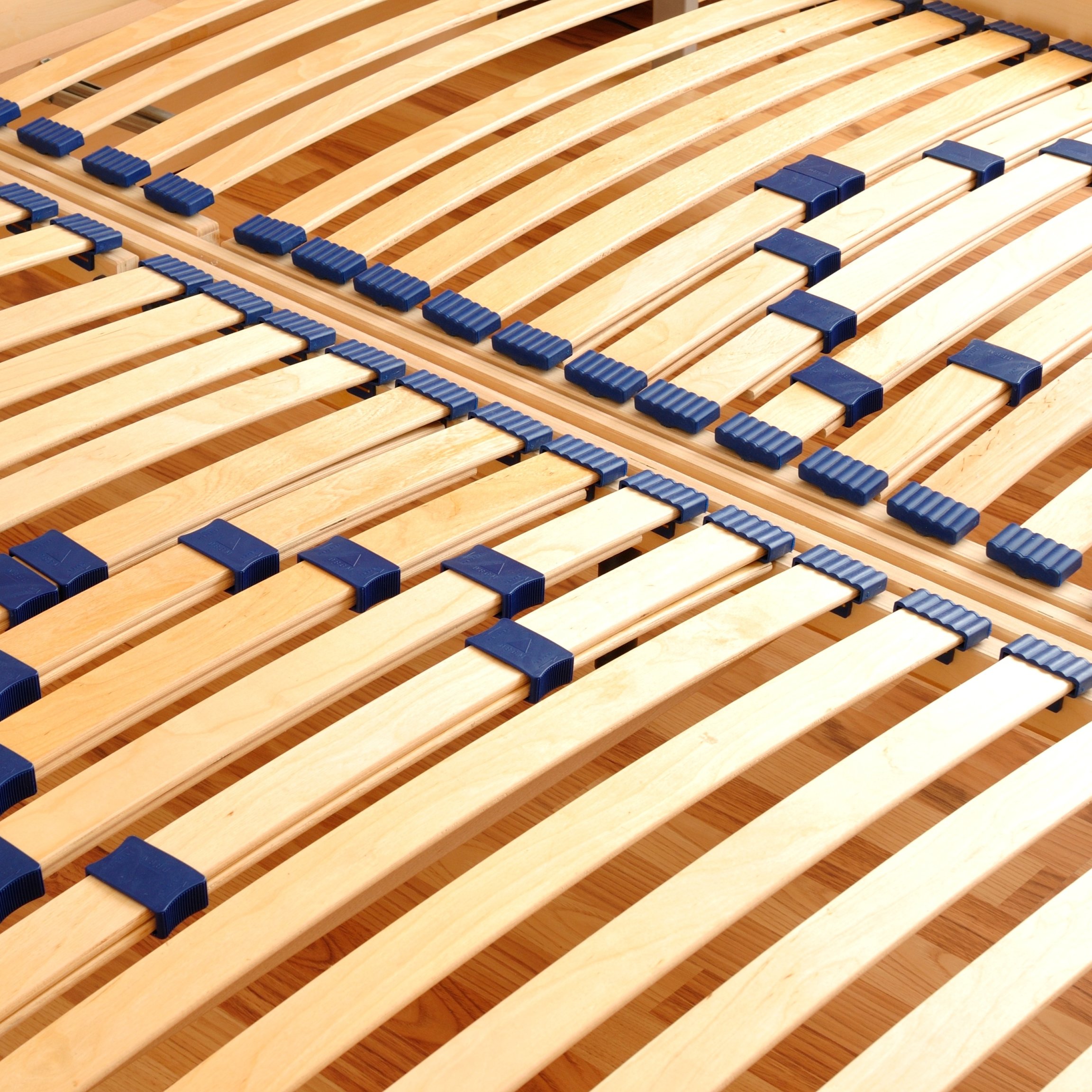
Follow four steps – first clarify your position, then adjust from the centre of the body outwards.
- Step 1: Identify your sleeping position. Over a few nights, notice which position you mostly fall asleep and wake up in: side, back or front. Your main position determines the basic setting.
- Step 2: Adjust the middle zone to your weight and pelvis. The heavier you are and the more your pelvis sags, the firmer you set the middle zone – depending on the slider type, you push inwards or outwards to do so. The aim: your pelvis lies in line with the rest of your spine instead of slipping into a hollow.
- Step 3: Adjust the shoulder area. This is mainly for side sleepers – the shoulder should be able to sink in softly so that the neck stays straight. If your base allows it, set the shoulder area to be more yielding.
- Step 4: Test by lying down and fine-tune. Lie down in your typical position and ask someone else to check whether your spine is straight. Then try it for a few nights and correct in small steps.
04 Adjusting by sleeping position
Each sleeping position makes different demands on the sleeping surface – here are the three basic cases.
Side sleepers
Setting up for side sleepers in three steps: set the shoulder area to soft so the shoulder sinks in; adjust the middle zone so the hip gives slightly but doesn’t sag; then check while lying down that your spine stays level. When you’re lying on your side, a surface that is too firm can put pressure on the shoulder and make the lower back bend sideways, while one that is too soft lets the pelvis sink. (Leilnahari et al., 2011)
A medium, well-zoned setting is usually the best compromise here.

Back sleepers
As a back sleeper, you mainly need support in the lower back. Set the middle zone slightly firmer so that the small curve of the lower back is kept and the pelvis doesn’t tilt away. If the lower back sinks in too deeply, this may encourage tension over the course of the night.
Front sleepers
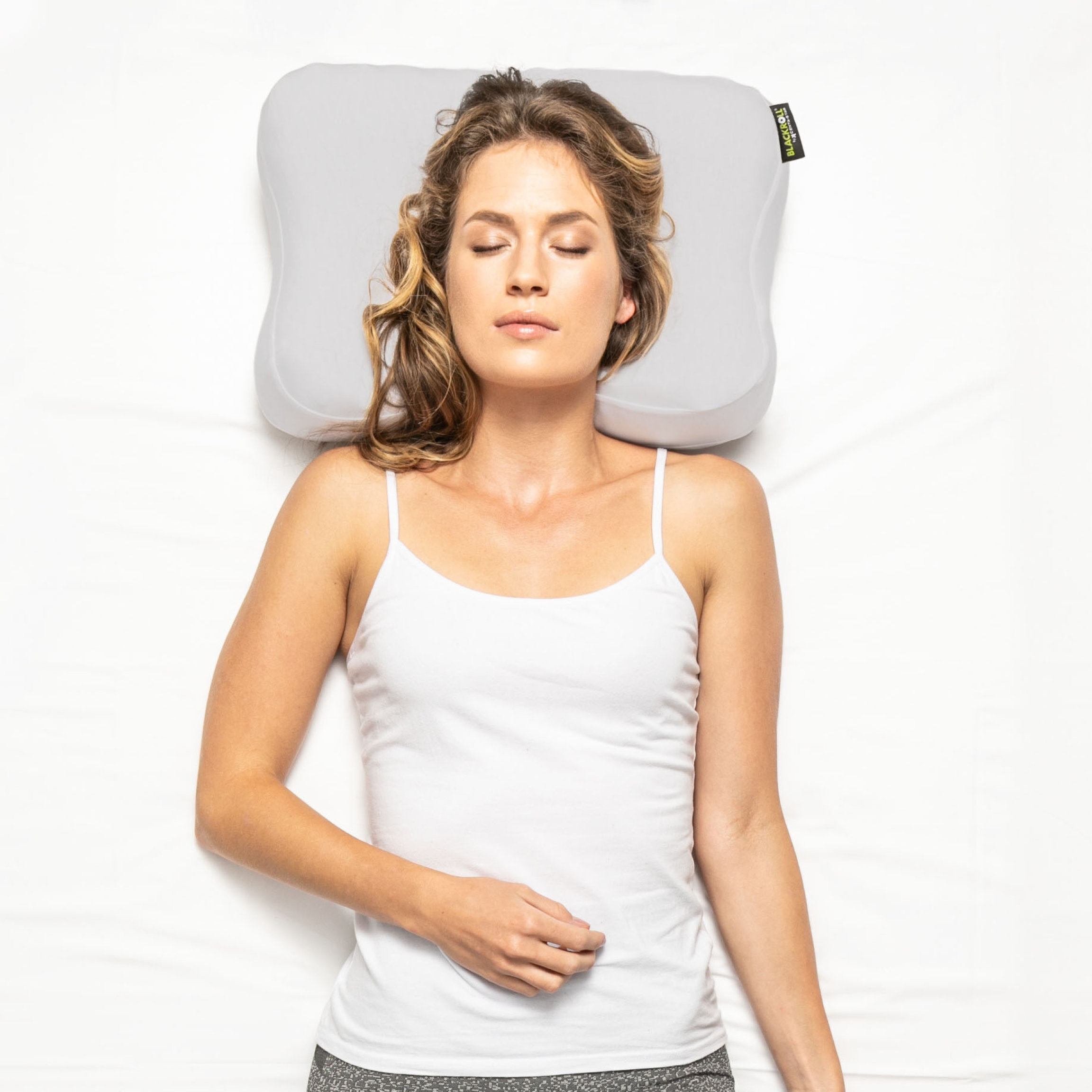
Sleeping on your front is the most demanding position for the back and, according to the research, is associated with a higher risk of back complaints. (Saini et al., 2025)
If you sleep this way, keep the middle zone on the firmer side so your stomach doesn’t sag and your lower back isn’t overextended. A thin pillow under the pelvis may also help.


Adjusting your slatted base for back pain
With back pain, the aim is a neutral spine with no sagging middle – not the firmest possible surface. A common misconception is that ‘firm’ automatically means ‘good for your back’.
Research on sleeping surfaces actually suggests the opposite: medium-firm, individually adjustable systems tend to be associated with more improvement than very firm ones in chronic, non-specific back pain. (Kovacs et al., 2003; Caggiari et al., 2021)
For the adjustment, that means: set the middle zone so that your pelvis is supported but doesn’t slip into a hollow, and so that your lower back keeps its natural curve. If your symptoms persist, it’s worth looking at the right mattress for back pain and the right firmness – the adjustment alone can’t make up for an unsuitable mattress.


Common mistakes when adjusting
Most incorrect settings happen because people expect the sliders to do something they can’t. You should avoid these points:
- Setting everything to ‘firm’ because it feels stable – a middle zone that is too firm may encourage pressure points and sideways bending.
- Leaving the shoulder zone too firm for side sleepers, so the shoulder can’t sink in.
- Judging straight after a change: your body needs a few nights to get used to a new setting.
- Considering the slatted base separately from the mattress – the two always work together
- Accepting slat spacing that is too wide with foam mattresses, which allows the mattress to sag between the slats.
Mattress type ↔ slat spacing: foam mattresses need slats that are closer together (rule of thumb: no more than about three centimetres apart) so they don’t sag. Pocket-sprung and latex mattresses are more tolerant.


When adjusting isn’t enough
Sometimes the slatted base isn’t the problem, but the interaction within the whole sleep system. To put it honestly: there is so far no robust long-term data on whether a particular sleeping surface prevents future back pain. (Bakker et al., 2009)
The sliders are a fine-tuning tool – not a cure.
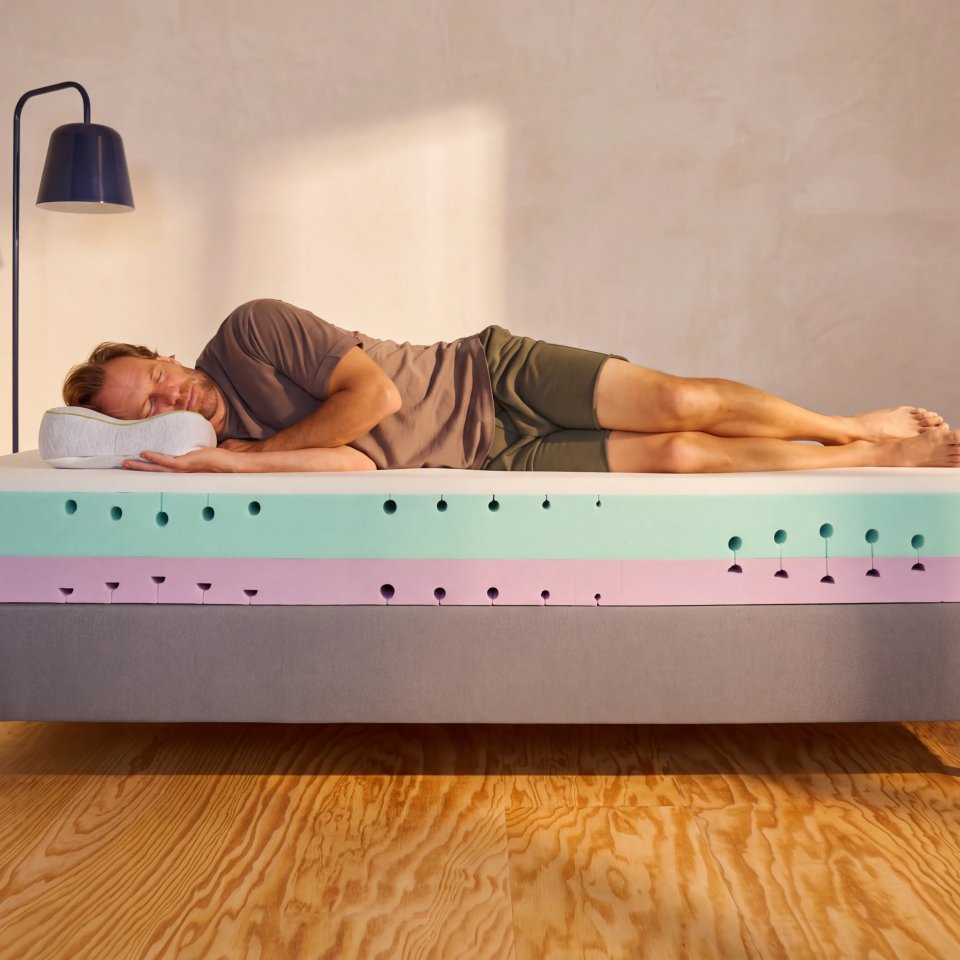
If your mattress is sagging, the wrong size or doesn’t suit your weight, even the best adjustment achieves little. In that case it’s worth looking at the complete sleep system: a well-matched mattress such as the BLACKROLL RECOVERY BASE 2.0 forms the foundation, while the slatted base takes care of the fine-tuning.
If you’re thinking about the frame too: our BLACKROLL SLATTED FRAME with its 7-zone construction, adaptive shoulder zone and Dynamic Lumbar Support (made in Germany) is currently only available from specialist retailers. And sometimes the simplest lever is the sleeping position itself.
For restful sleep
Recovery Base 2.0
Available in multiple variants
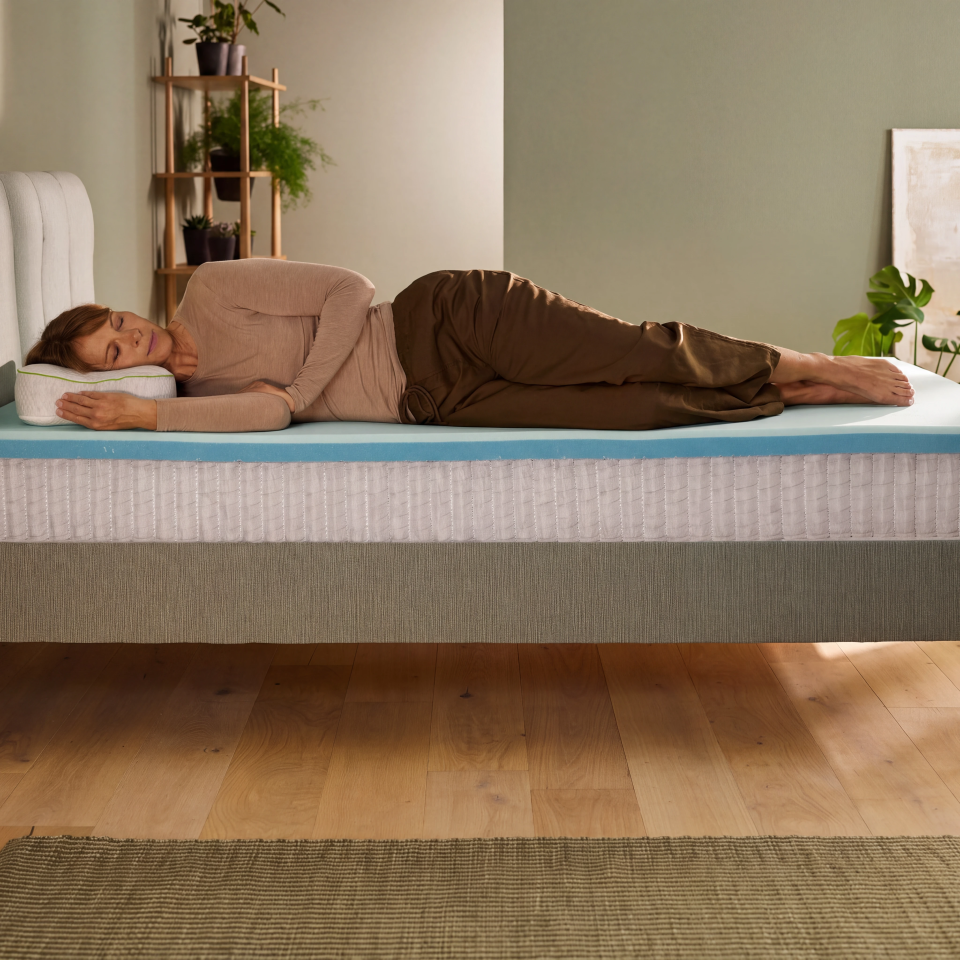
Recovery Base Balance
Available in multiple variants
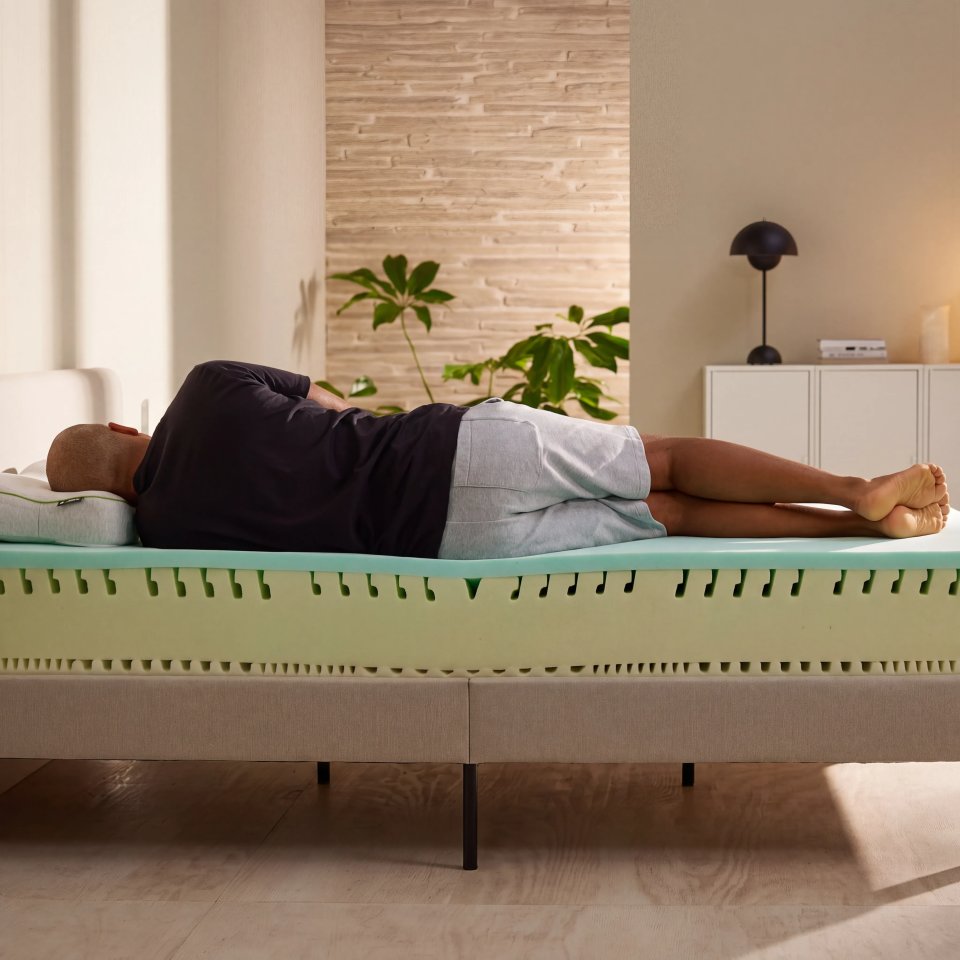
Recovery Base Elite
Available in multiple variants
08 Conclusion
Adjusting the slatted base is an effective but limited tool: it can bring your spine closer to a neutral posture and improve comfort – provided the mattress and base fundamentally suit each other. Set the middle zone according to your weight and position, give your shoulder room when sleeping on your side and give every change a few nights.
If symptoms persist despite a careful setup, the next lever is usually the mattress – not the sliders.


FAQs: the key questions on adjusting a slatted base
Set the shoulder area to soft so the shoulder can sink in, and adjust the middle zone so the hip gives slightly without sagging. Then check while lying down that your spine runs level. A medium setting is usually better than a very firm one. (Leilnahari et al., 2011)
The aim is a neutral spine, not maximum firmness. Set the middle zone so that your pelvis is supported but doesn’t slip into a hollow. According to the research, medium-firm, adjustable sleeping surfaces tend to be more favourable here than very firm ones. (Kovacs et al., 2003; Caggiari et al., 2021)
That depends on the design: with T-sliders, you push them further towards the centre in the middle zone; with O-sliders, further outwards. Firmer is mainly sensible if you have a higher body weight or sleep on your back. After adjusting, check by hand that the zone has really become firmer.
The sliders change the give in the middle third of the base. Which way you need to push them depends on the design – with T-sliders it becomes firmer towards the centre, with O-sliders towards the outside. They allow fine-tuning for the pelvis and lower back, but can’t make up for an unsuitable mattress.
That depends mainly on the type of mattress. Foam mattresses need slats that are closer together (about three centimetres apart) so they don’t sag. Pocket-sprung and latex mattresses are more tolerant. What matters is to consider the mattress and base as a system.
That depends on your daily routine. Tiltable head and foot sections can be handy for reading, getting up or care. For simply sleeping through the night, they often add little – so the extra cost isn’t worth it for everyone.
You might also like






Sources
Kovacs, F. M., Abraira, V., Peña, A., Martín-Rodríguez, J. G., Sánchez-Vera, M., Ferrer, E., … Mufraggi, N. (2003). Effect of mattress firmness on chronic non-specific low back pain: a randomised, double-blind, controlled, multicentre trial. The Lancet, 362(9396), 1599–1604. https://doi.org/10.1016/S0140-6736(03)14792-7
Radwan, A., Fess, P., James, D., Murphy, J., Myers, J., Rooney, M., Taylor, J. and Torii, A. (2015). Effect of different mattress designs on promoting sleep quality, pain reduction and spinal alignment in adults with or without back pain: A systematic review of controlled trials. Sleep Health, 1(4), 257–267.
https://doi.org/10.1016/j.sleh.2015.08.001
Caggiari, G., Talesa, G. R., Toro, G., Jannelli, E., Monteleone, G. and Puddu, L. (2021). What type of mattress should be chosen to avoid back pain and improve sleep quality? Review of the literature. Journal of Orthopaedics and Traumatology, 22(1), 51.
https://doi.org/10.1186/s10195-021-00616-5
Leilnahari, K., Fatouraee, N., Khodalotfi, M., Sadeghein, M. A. and Kashani, Y. A. (2011). Spine alignment in people during the lateral sleeping position: an experimental study and modelling. BioMedical Engineering OnLine, 10, 103.
https://doi.org/10.1186/1475-925X-10-103
Saini, Y., Rai, A. and Sen, S. (2025). Relationship between sleep posture and low back pain: A systematic review. Musculoskeletal Care, 23(2), e70114.
https://doi.org/10.1002/msc.70114
Bakker, E. W. P., Verhagen, A. P., van Trijffel, E., Lucas, C. and Koes, B. W. (2009). Spinal mechanical load as a risk factor for low back pain: a systematic review of prospective cohort studies. Spine, 34(8), E281–E293.
https://doi.org/10.1097/BRS.0b013e318195b257