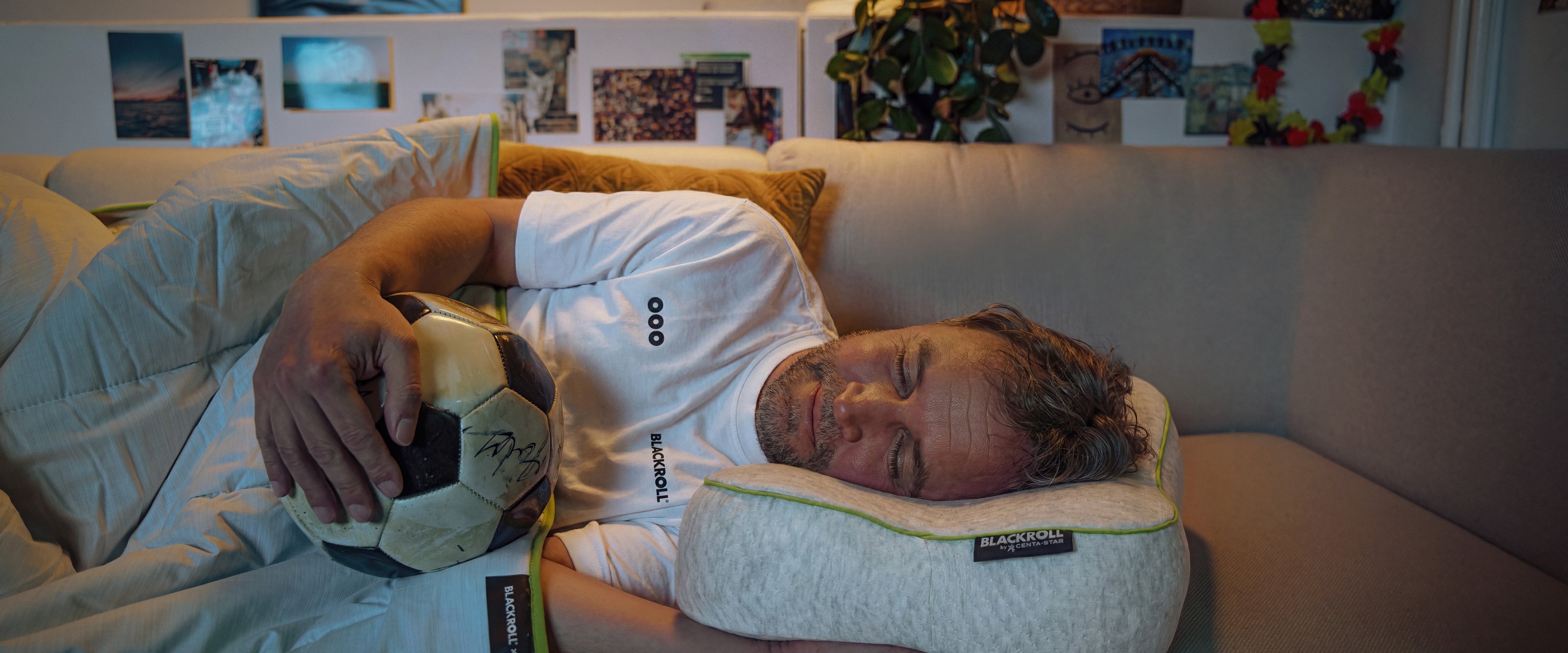
“Final whistle. Now what?” – Anna West on the toughest hour of the day
Three climate zones, a nine-hour time difference, 90 minutes of adrenaline. Here’s what sleep performance coach Anna West advises pros and fans when the body won’t shut down.
It’s 11:42 p.m. at a hotel in Houston. The final whistle blew seven minutes ago. The bus pulls up in front of the entrance, a door slams, footsteps on the carpet. Then someone inserts the key card into the lock—and the two large spotlights above the bed flare up like studio lights.
That, says Anna West, is exactly the wrong moment.
“I always say: When you walk into your hotel room at this stage, put on sunglasses if you have to, or pull your hood over your head. It sounds silly. But the light at that moment will cost you the whole night.” — Anna West, Sleep Performance Coach
Anna laughs as she tells this story. But the image sticks with you.

The car on the highway
If you’ve been in the “red zone” for 90 minutes, you can’t just lie down and fall asleep. That’s not a weakness. It’s biology. Anna West has been working for years with professional soccer players who juggle the Champions League, the Bundesliga, and the national team every week. She has a metaphor for this that everyone can understand.
“It’s like a car on the highway. You’re driving 200 km/h. You can’t just hit the brakes and expect it to stop. What happens: You skid, you lose control.”
What happens in the body is a hormonal spiral. Adrenaline surges. If you then start forcing yourself to sleep, you produce additional cortisol. And cortisol blocks melatonin production—the very hormone we need right now.
“The harder you try to sleep, the further away sleep gets. That’s the trap,” Anna explains.
Entdecke die DFB Sleep Produkte
Acceptance, Not Optimization
Anna’s first step isn’t a tool. It’s a mindset.
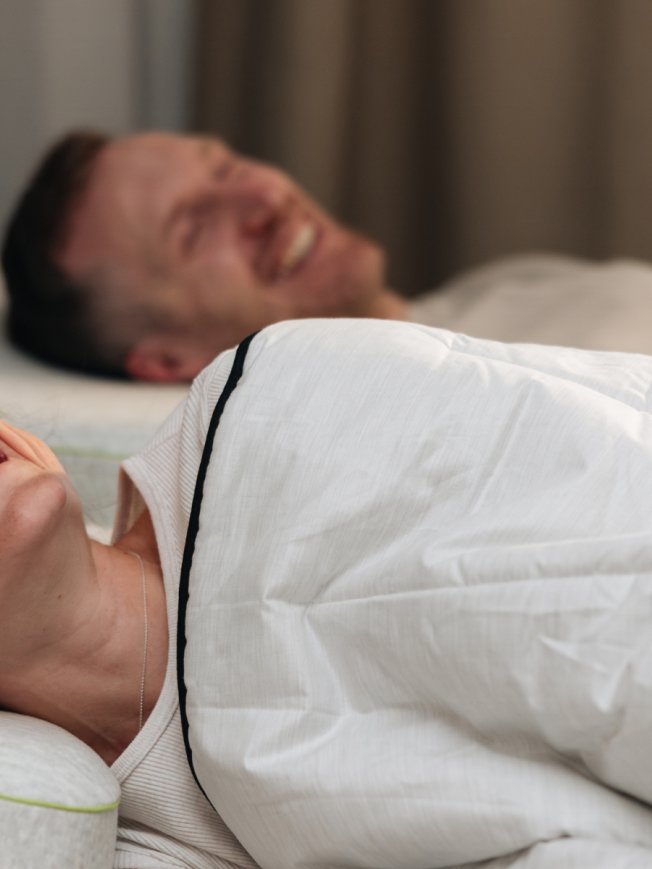
Acceptance instead of optimization. Anyone who sets out to fall asleep in 15 minutes because the sleep log says so is setting themselves up for failure. Anyone who accepts that the first 30 or 45 minutes are a transition—a wind-down, not a sudden stop—is more likely to get there.
“The first half-hour isn’t sleep time. It’s preparation. Anyone who understands that becomes calmer. And anyone who becomes calmer falls asleep faster.”

Schlaf als Leistungsträger: Experteneinblicke von Anna West für optimale Erholung im Profisport
Zum InterviewThe Menu, Not a Prescription
A toolkit instead of a one-size-fits-all solution. Anna doesn’t want to prescribe anything; she wants to offer a selection from which everyone can choose what works for them.
- Warm shower. Your core body temperature rises briefly and then drops—a signal to sleep.
- Indirect light. Where possible: turn off the spotlights, turn on the desk lamp. Where not: put on sunglasses or a hoodie when entering the room.
- Conscious breathing. Inhale for four seconds, exhale for seven. Three minutes is often enough.
- A book. A mystery, a novel—anything is better than social media.
- A movie, too. If it helps you unwind—yes. But Anna sets a limit:
“If a movie takes you to a different mental space for 10 minutes, that’s probably more helpful than forcing yourself to skip it. But: 10 minutes, then check in. Where am I now? Am I ready to give it a try?”
What she doesn’t recommend: doom-scrolling. Game analyses on X. Comment sections. “That’s not slowing down,” says Anna. “That’s full throttle with a different steering wheel.”
Meditation? Only if you like it.
A statement from Anna that often surprises coaches.
“I’ve met so many players who knew that meditation was supposed to be good for them. They tried it so tensely that it had the opposite effect.”
If it doesn’t feel natural, don’t force it. There are better tools for managing your own mind. Anna puts it succinctly: “We don’t need a perfect ritual. We need one that really works.”
Same Biology, Different Game
Many people know this feeling from public viewings, too. You come home at night, completely exhausted—and yet you lie awake. Your mind is still replaying the last scene, the penalty kick, the equalizer in stoppage time. Your body has long since played along with the game.
What applies to a pro after the game applies almost identically to fans after a public viewing.
“Fans don’t have 90 minutes of playing time. But they have the same system. They need the same tools.”
Adrenaline after a last-minute victory. Excitement after a dramatic penalty shootout. Cortisol after a loss. Your body doesn’t distinguish between whether you were playing or cheering—it reacts.
And that’s exactly why the same tricks work: dim the lights, take a warm shower, breathe for three minutes. Watch an episode of your favorite show, then check in. Acceptance instead of forcing it.
Smart, or smart about it
Anna has a closing line that’s long since become a catchphrase among her athletes. It works for anyone who gets up in the morning after a short night’s sleep.
“We want them to do the smart thing. But if they forget to do the smart thing, they have to be smart about it.”
A bad night won’t destroy you. What saves the day after is not the hour you didn’t sleep—but the first 30 minutes after you get up. Light, water, movement. In that order.
Read more about how to turn a bad night into a good morning in the in-depth interview with Anna West.


