
Road to Ultra – Training for an Ultramarathon
Daniel is lying on the ground. He doesn’t know whether to laugh or cry. He just crossed the finish line of the Bizau Trail 2023. Now it’s all hitting him at once: exhaustion, joy, pride, fatigue, pain, the cold, and a decision. He wants to see what he’s capable of one more time. Finishing a major ultratrail: the Pitz Alpine Glacier Trail.
Jogging, running, trail running. There are many forms of what is arguably the most primal of sports. And at some point, most runners dream of running a marathon. And some dream of even more: for example, an ultramarathon. That’s the term used for all races longer than the marathon distance—that is, over 42.195 kilometers. Many ultra runs include thousands of meters of elevation gain and follow narrow trails. These races are called ultratrails.
“For me, trail running means running off paved roads. Ideally, these are narrow paths with varied terrain that wind through the mountains,” says Daniel Leidorf, Digital Marketing Manager and SEO Specialist at BLACKROLL®.
The 2023 Bizau Trail was a preparatory run for him—a test of his fitness. But it was a special run through the Bregenzerwald. Over the 30 kilometers, runners not only had to tackle 1,900 meters of elevation gain, but the weather also pushed them to their limits. Rain, sleet showers, fog, snowfields, mud. And Daniel right in the middle of it all. Trail running is extreme in conditions like these. But that’s exactly what Daniel loves.
For him, it’s not about running as fast and as long as possible under perfect conditions. He seeks out the challenge. On that day in May, he took it on.
And he made a decision: He’ll compete once again in the Pitz Alpine Glacier Trail (PAGT), one of the toughest ultratrail races in the Alps. The distance is 106 kilometers, and participants must climb 6,100 meters of elevation gain during the race. For this P105 distance, the finish rate is just 20%.
Why ultratrail? Are you crazy?
A question Daniel often hears is why he does all this—whether he’s running away from something. And in a way, that’s true. But as with any hobby—even an extreme one—it all starts out quite normally. Daniel has always been an athlete; he took the advanced sports course in high school, went on to study sports science, played soccer for a club, rode his mountain bike across the Alps, and simply loves being active outdoors and pushing himself to the limit.
In 2014, he started trail running. While his wife was pregnant, he didn’t want to spend too much time on the mountain, so he simply ran up it faster. He calls it “speed hiking.” And that, of course, led to trail running.
At first, he runs 20 kilometers, then 40, then 60. His next big goal is to run over 100 kilometers, and he chooses the PAGT for it. Of all things. That was in 2019. Daniel fails.
But long-distance running is addictive—and because athletes don’t give up so easily, he was back at the starting line in 2020. This time, he was better prepared, with a coach and a structured training plan. At the finish line, he got to put on his finisher’s medal. An indescribable feeling.
In 2021, he successfully ran the 45-kilometer course alongside his wife, whom he’d since infected with the ultra-trail bug. Then came a break, due to COVID-19 and an injury. The addiction remains.


Work-Life-Wife-Sport Balance
Now 40 years old, Daniel wants to give it another go. He wants to prove to himself that his job, family, dog, and his extreme hobby are compatible. He wants to relive the emotions that can only be found at the finish line of an ultra-run. But Daniel also knows it won’t be easy.
“At 40, I’ve noticed that I don’t recover as quickly as I did three years ago. The year-long break after contracting COVID-19 probably played a part in that, too. I have to invest more time, both in recovery and in injury prevention,” says Daniel.
Time that he has to manage carefully. Because in addition to his full-time job at BLACKROLL® and his time-consuming long-distance runs, he doesn’t want his family to feel neglected. Although his two daughters (7 & 10) are just as passionate about sports as their parents, they naturally don’t want to be without their father.
His wife has given him the green light for his attempt and promised her full support. She’d rather her husband prepare properly than have to try again next year.
True to the motto: Now or never.


Here’s what a training plan for an ultra-trail looks like
For Daniel, this means going “all in” during his preparation: getting up early and biking to work—20 kilometers each way, morning and evening. That’s on the schedule for Mondays, Tuesdays, and Thursdays. Late in the evening, once the kids are in bed, he does stretching and mobility exercises as well as fascia training.
Here you can check out the injury prevention exercises for runners that Daniel uses to prepare.
On Wednesdays, the first running session of the week is on the schedule. Daniel covers 15 to 20 kilometers during this session. But that’s not the end of the day. Since the risk of injury in trail running is high, strength and stability training sessions are essential. A recent study on injury prevention for runners conducted by the University of Gothenburg showed that targeted strength and fascia training can reduce the risk of injury among runners by 85%.
Daniel also runs on Thursday, either before heading to the office or when he gets back in the evening. He runs and runs and runs, but this time at an easy pace. He combines this with more BLACKROLL® exercises. Friday brings a bit of a break. It’s time for stretching, stability, and flexibility exercises.
Then things get serious over the weekend. No work, no kids to take to school. Instead, plenty of time for long sessions, but always at a relaxed, basic intensity. For example, on a bike or during a 4-hour run. On Sunday, he might push it a bit more—not fast, but the main thing is to stay on his feet for a long time.
“After the weekend sessions, I’m usually completely wiped out. That’s when I always look forward to a big plate or two of pasta, my compression boots, and some relaxing time with the family,” Daniel says.
But he also tries to include family and friends during his weekend training sessions. Sometimes friends run part of the route with him; other times, his family takes the cable car to a summit that Daniel then climbs on foot. After lunch together, Daniel heads out for the next leg of his run, and everyone meets up again down in the valley. Even his vacations are meticulously planned. It was no coincidence that his itinerary took him through Chamonix, a paradise for trail runners and the site of the UTMB—the Ultra-Trail du Mont Blanc.
For Daniel, recovery is almost as important as training. It’s a proven fact that a 40-year-old body doesn’t recover as well as one that’s 20 years younger. In addition to active recovery—such as stretching, compression boots, and fascia and mobility training—passive recovery, namely sleep, is also a key factor for Daniel. He needs to get enough sleep—at least 7–8 hours—and on a regular basis.
“I’ve created a healthy sleep environment with our products and try to stick to my sleep schedule every day so that I’m fit again the next day for work, family, and my training.”
You can read all about healthy sleep here.
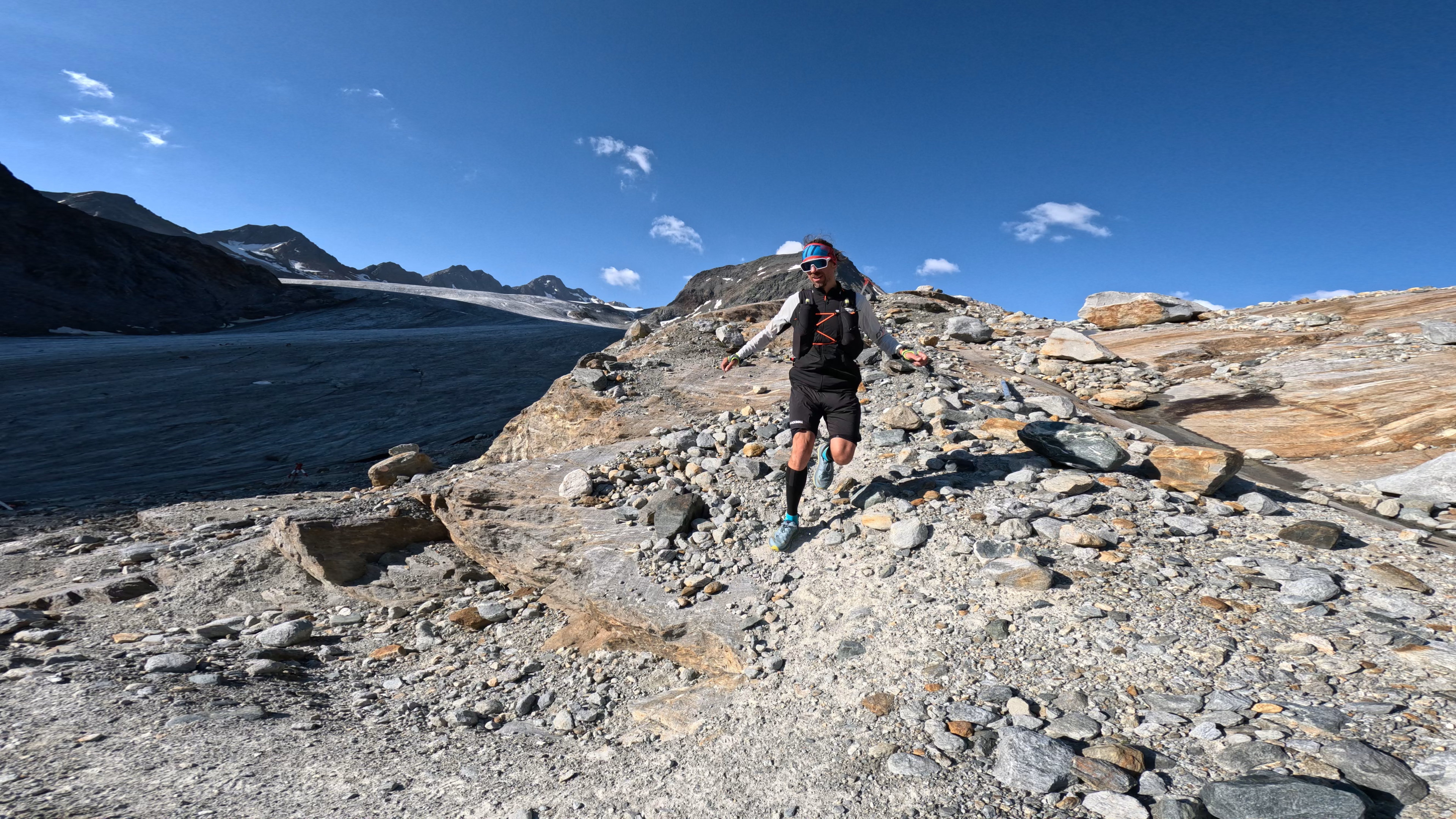
Breathing, Heartbeat, Body
Sure, Daniel wants to prove to himself once again that he’s still in top shape even at 40. But what’s really important to him? It’s not victory he’s after. “I’ve never been the absolute best at any sport,” Daniel admits, but adds with a grin, “I’m pretty good at torturing myself, though.”
But it’s not the pain Daniel is seeking either. He simply wants to discover his own limits. Preferably not through failure—a DNF (Did Not Finish), meaning giving up on the race—but through a state of flow, where everything just clicks, he can enjoy the Pitztal valley scenery, his mind completely shuts off, the worries of everyday life fade away, he forgets about his next work deadline, and vacation plans don’t matter.
“Being completely at one with myself is the goal. When only my breathing, my heartbeat, and my body matter, I’ve achieved it,” Daniel says.

It’s All in the Mind
Each trail runner decides for themselves what percentage is attributed to training, nutrition, and mental strength in ultratrail running. Daniel puts it at 25, 25 to 50.
One thing is certain: anyone who hasn’t prepared for worst-case scenarios—such as hunger, fatigue, pain, negative thought spirals, weather, cold, heat, or equipment failure—will have absolutely no chance of running such long distances in the mountains.
At that point, you have to stay calm, analyze the situation, accept it, solve the problem, and above all, don’t stop. But even with the best preparation, there comes a point when everything is decided in your head.
When the pain can no longer be ignored, your feet are bleeding, and your body simply won’t go on. No more running, no more eating—just nothing. “I can’t prepare for scenarios like that, but I can come to terms with them. And when they happen, I have to accept them, greet them with a friendly smile, and then just keep running. Until the flow comes back. Or until the finish line,” Daniel smiles.
Preparation is going well! Training weeks with 100–120 kilometers of running and “prep races” over 50 km with 4,500 meters of elevation gain, as well as the 24-hour race at Rad am Ring with the BLACKROLL® team, are going smoothly and without any major issues. Sometimes his back would twinge, sometimes his calves or hip flexors, but it was always within tolerable limits.
Then it was finally here! Race Day!