Sleeping Positions for Couples: Tips for Restful Sleep and a Healthy Relationship

The Perfect Sleeping Position for Couples – Find Your Ideal Sleep
Good sleep is essential for our health—but when you share a bed with your partner, finding the perfect sleeping position can be a challenge.
While some people like to fall asleep snuggled up close together, others need more space to truly unwind. But how does your shared sleeping position affect sleep quality—and even your relationship?
In this article, you’ll learn which sleeping positions are ideal for couples, what health benefits they offer, and how you can both meet your individual needs. This way, you’ll not only get restful sleep but also strengthen your relationship—night after night.
Popular Sleeping Positions for Couples
The diversity of sleeping habits reflects the breadth of human relationships. It becomes particularly interesting when two people have to combine their individual preferences. Sleeping positions for couples offer a window into intimacy, comfort, and even personality and the depth of their relationship.
There are a number of common positions that couples frequently adopt:
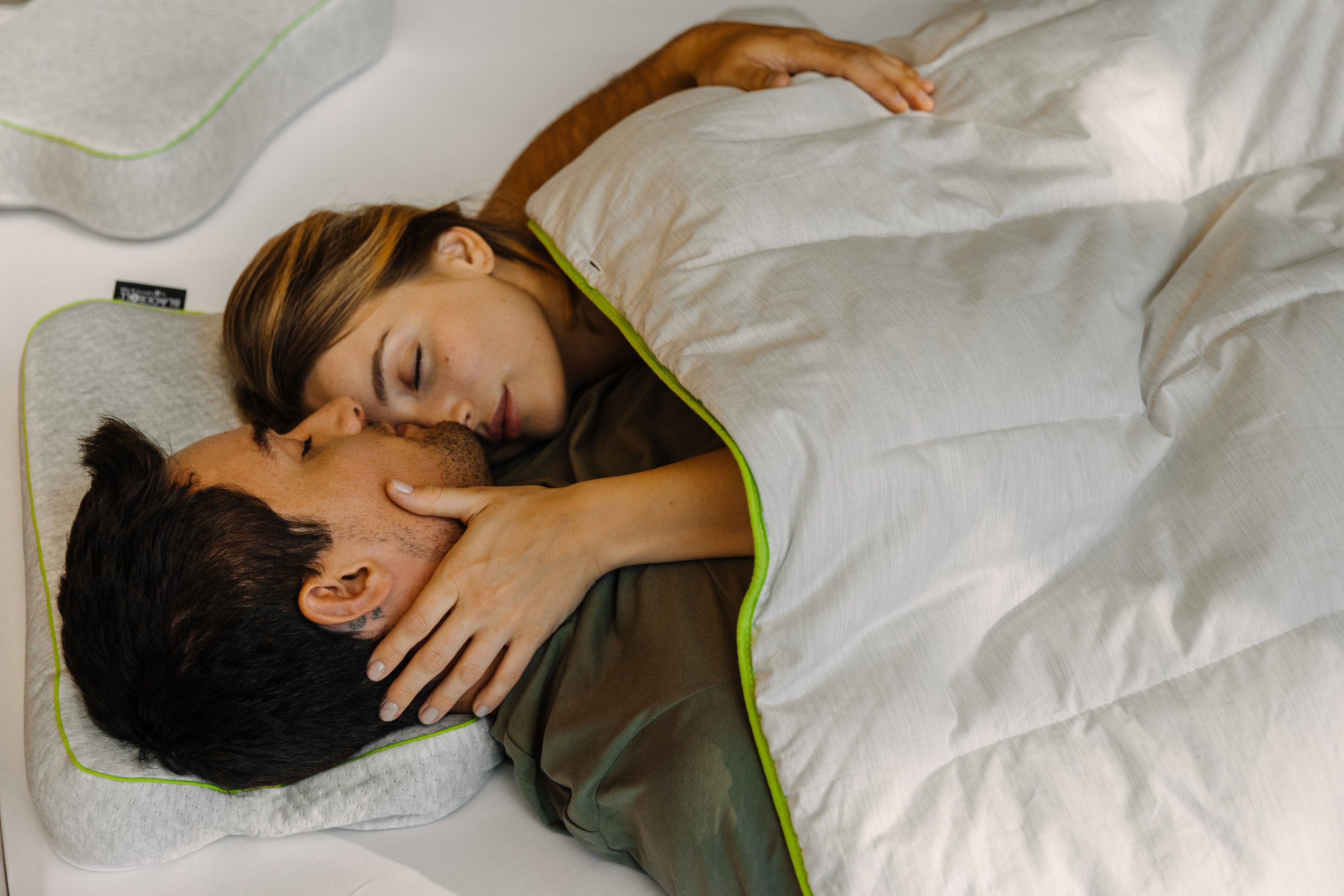
- Spooning: One of the most popular positions, in which both partners lie on their sides, curled up together. This creates a sense of security and closeness and fosters contact and bonding.
- Mirror spooning: A variation of the classic spooning position, in which the partners lean against each other back-to-back. This position offers personal freedom while still allowing for contact.
- Face-to-Face: This position conveys familiarity and intimacy, as both partners turn their faces toward each other. It’s often chosen by couples who like to talk at night or seek eye contact.
- Clear Space: Each person has their own space on the bed, perhaps with only occasional contact between their legs or feet. This sleeping position often indicates a need for independence within the relationship.
- Intertwined Legs: This subtle connection, in which the legs are intertwined, suggests a quiet togetherness and unspoken support, while both people maintain their individual space.
The choice of a sleeping position can stem from various reasons—ranging from personal comfort to emotional needs. Regardless of the preferred position, the choice of mattress and pillows is crucial for ensuring a restful night’s sleep. The interaction is also fascinating: by trying out different positions, you may uncover deeper levels of your relationship and enhance your nighttime experiences.
Differences in Sleep Habits
Couples’ sleep habits are much more than just a matter of personal comfort—they influence not only the quality of sleep but also the dynamics of the relationship.
Preferred sleeping positions can vary greatly depending on temperament, individual health needs, or simply out of habit.
While some couples find the closeness of the spooning position soothing and intimate, others prefer the back-to-back approach to have more personal space.
There’s no right or wrong here—the key is that both partners feel comfortable and get a restful night’s sleep.
To ensure both partners can fully recharge, it’s essential to customize the sleeping environment to their individual needs. A mattress firmness tailored to personal needs can help prevent muscle tension and provide optimal support for the spine throughout the night. Choosing the rightpillow and duvet also plays a crucial role.
In addition to choosing the right mattress, small adjustments can also improve sleep quality: a comfortable room temperature, separate blankets for different warmth preferences, or reducing disruptive factors such as tossing and turning or snoring at night.
In some cases, even occasionally sleeping in separate beds can be a solution to help each person achieve the best possible rest. It’s crucial that both partners take their sleep needs seriously—because only those who sleep well can invest in their relationship with full energy the next day.
The Effects of Sleep Position on Health
The way we sleep affects not only our physical recovery but also hormonal processes that play a key role in regulating our well-being. A key hormone here is oxytocin, often referred to as the “cuddle hormone.”
It is released through physical contact and promotes not only emotional closeness but also stress reduction, a more stable heart rate, and a stronger immune system. Sleeping positions that allow for closeness can enhance this effect and promote deeper relaxation.
However, not every sleeping position has the same positive effect on health. An unfavorable position can strain the spine, restrict breathing, or contribute to tension in the shoulders and neck.
People who frequently wake up with back pain or circulatory problems should take special care to ensure that their sleeping posture provides the best possible support for their body.
Nighttime movements are also influenced by the chosen position. While some people sleep almost motionless, others frequently change their posture. Striking a balance between closeness and freedom of movement can help you sleep undisturbed while still benefiting from the calming effect of sleeping together.
Those who listen to their bodies and make adjustments as needed can not only reduce tension and sleep problems but also optimally support nighttime recovery.

Tips for a better sleeping position as a couple
Finding a comfortable and restful sleeping position as a couple often requires just a few small adjustments. Here are 5 tips that can positively impact your shared sleep experience:
While close physical contact promotes the release of oxytocin and strengthens a sense of security, many people also need freedom of movement to sleep undisturbed. Be sure to choose a position that offers both of you closeness as well as enough space for a restful night’s sleep.
The ideal sleeping position is one that keeps your spine in a neutral alignment. If you sleep on your side, placing a pillow between your knees can relieve pressure on your hips and back, while back sleepers should make sure their neck is well supported. Work together to figure out which position allows both of you to get the best rest.
Different sleeping habits—whether temperature preferences, sensitivity to movement, or preferred mattress firmness—can easily become disruptive factors.
Individual blankets, an adjustable mattress—such as our BASE—or separate pillows can help ensure that everyone feels optimally supported without disturbing the other person’s sleep.
The RECOVERY BASE mattress can be adjusted to different firmness levels and is also available in various sizes. Are you tired of constantly ending up in the gap between you and your partner when you snuggle up? Our COMFORT TOPPER can help with that. Our mattress topper offers you even more sleeping comfort. By providing even pressure relief, it specifically supports your spine and hips and adapts perfectly to the contours of your body.
Snoring, frequent tossing and turning, or a restless night can quickly become a burden. Measures such as finding a suitable sleeping position to improve breathing, maintaining a comfortable room temperature, or establishing a consistent evening routine for relaxation ensure that both partners can sleep undisturbed.
Sleep problems in relationships are often not actively addressed, even though they can affect the quality of sleep for both partners. Talk openly about what helps you sleep well, and be willing to make adjustments together. Small changes can have a big impact—leading to better sleep and a stronger connection.
There’s no such thing as the “perfect” sleeping position for a couple—what matters is that both of you feel comfortable and wake up feeling refreshed. A good balance between closeness and individual comfort, proper support for the body, and open communication about sleep needs are the keys to a restful night’s sleep. Small adjustments can make a big difference—leading to better sleep and a harmonious relationship
Solutions for common problems when sleeping as a couple
Different sleeping preferences and habits can make sharing a bed a challenge. Finding the right sleeping position for couples is crucial for waking up well-rested at night. Among the most common problems are lack of space, differing temperature needs, and movements that disturb your partner.
If sleep cycles differ, this can lead to disturbances. If one partner is an early riser, using dim lighting and soundproof curtains has proven effective.
Another key factor is sleep chronotype. Not everyone follows the same internal rhythm—while so-called “larks” go to bed early and wake up early, “owls” tend to be more nocturnal and have a hard time getting out of bed in the morning. Then there are mixed types who fall between these two extremes. If the chronotypes in a relationship differ, this can lead to disturbances.
- If one of you is a “lark”—that is, an early riser—it can help to use dim lighting and soundproof curtains so as not to wake your partner. If the other person stays up later, eye masks or earplugs are a practical solution.
- If the “night owl” goes to bed later, they can try to avoid activities involving bright screen light or wind down in the living room instead of the bedroom so as not to disturb their partner.
- If your sleep rhythms are consistently out of sync, you can also try slightly shifting your sleep-wake cycles—for example, by establishing shared bedtime rituals like cuddling or reading before the night owl engages in a quiet activity.
- Short on space? Try optimizing your room layout. A larger bed with two separate mattresses might be the solution.
- Temperature differences? Different comforters can help.
- Snoring? Changing positions or using a nasal strip can help.
- Hard or soft? Different mattress firmness levels can make all the difference when it comes to anatomical differences or personal preferences. Using two mattresses can also reduce nighttime awakenings.
By addressing individual needs and creating the ideal environmental conditions, a harmonious sleeping environment can be fostered. Neutral colors and the right pillow or mattress topper—to prevent ending up in the “gap” between partners while cuddling—can further contribute to well-being. In fact, choosing an optimal sleeping position for couples often results in a noticeable improvement in nighttime rest.

Do couples sleep better than singles?
There’s no one-size-fits-all answer—while some people benefit from closeness and a sense of security, others sleep better when they’re undisturbed. The key is to know your own needs and to set up your sleep environment in a way that allows for optimal rest—whether you’re alone or with a partner.
Sleeping Positions and Relationship Dynamics
One fascinating aspect of our nighttime habits is the sleeping positions that couples adopt. Each of us has our own preferred sleeping position, but when it comes to couples, an interesting dynamic comes into play. A couple’s preferred sleeping position can reveal a lot about their relationship dynamics.
For example, couples who sleep back-to-back often tend to feel secure enough individually to keep their distance from one another while sleeping. This position often indicates independence and mutual trust. Another commonly observed position is sleeping in the spooning position, which is a sign of closeness and security in the relationship. Interestingly, one partner often takes on the protective role by lying behind the other.
However, those who sleep more freely or spread out in bed might be creating more space for independence in the bedroom. For these couples, it can be helpful to reflect on their personal space and their own sleeping habits. Consciously observing one’s own sleep patterns and those of one’s partner could serve as a starting point for recognizing and reflecting on potentially unconscious relationship dynamics.
However, the point is not to categorically judge sleeping positions or attach too much significance to them. A good balance between personal comfort and communication between partners is crucial. Everyone should be able to maximize their sense of calm and rest. It may also be important to make occasional adjustments, whether with comfortable sleep products—such as a new mattress or the right pillow—or by establishing a new evening or bedtime routine.
An Overview of Evening and Sleep Routines
Find a routine that helps you wind down in the evening. Relaxation exercises can help you and your partner fall asleep faster.


Conclusion: How to Find the Ideal Sleeping Position for You Both
To discover the ideal sleeping position for couples, it’s important to be aware of each other’s individual needs and preferences. Each partner brings their own sleep habits and needs to the relationship, so flexibility is key. Sleeping positions like “spooning,” where partners snuggle close together, promote intimacy and a sense of security. However, this position can cause you to get too warm, which isn’t for everyone. Alternatively, positions where both partners sleep back-to-back are a good option for ensuring both closeness and freedom of movement.
Combine your personal preferences for closeness, comfort, support, and temperature regulation to create a sleeping environment that works for both of you. That way, as a couple, you’re sure to enjoy restful nights before long.
Ideal Products for Restful Nights as a Couple


Pillow Case Jersey
Available in multiple variants