Do you want to take your training to the next level and work specifically toward your athletic goals? Training zones are the key! They not only give you control over your training intensity but also help you challenge your body optimally without overloading it.
Whether it’s recovery, building basic endurance, or reaching your anaerobic threshold —each zone activates specific physiological processes that improve your performance step by step. When you understand how to use these intensity zones correctly, you’ll get the most out of your training and achieve your goals more effectively than ever before.
Are you ready to revolutionize your training plan?


The Importance of Training Zones
To get the most out of your workout, choosing the right training zones is crucial. These zones help you optimize the intensity of your physical effort. Depending on your fitness goal—whether it’s burning fat or improving endurance—the appropriate heart rate ranges will vary.
If you understand the differences between the various zones, you can tailor your workout more precisely and achieve lasting progress. For fat burning, for example, the moderate-intensity zone is ideal, where you should aim for about 60–70% of your maximum heart rate . This zone promotes metabolic efficiency and supports weight loss.
To build endurance, it makes sense to exercise in the aerobic zone
Here, the heart rate range is between 70 and 80% of your maximum heart rate. During this phase, both oxygen uptake and cardiovascular performance improve. Athletes who exceed the anaerobic threshold often see an increase in their performance during short, intense bursts of exercise. In this zone, starting at about 80% of your maximum heart rate, lactate metabolism is intensively stimulated.
Use these zones strategically and combine them in your training plan to create a balanced and effective program. Adjusting training intensity can also help prevent injuries and optimize recovery.
Exercises for Runners




How to Determine Your Personal Training Zones
To determine your optimal training zones, we’ll start by calculating your maximum heart rate. This can be determined through an intense endurance test in which you push yourself to the point of complete exhaustion. Alternatively, the formula “220 minus your age” offers a quick, albeit less accurate, estimate. A scientifically sound method—and often more reliable—is determining your anaerobic threshold. This represents the point at which your body switches from an aerobic to a predominantly anaerobic energy supply.
The body switches from an aerobic—that is, oxygen-based—energy supply to a predominantly anaerobic one when the exertion becomes so intense that the oxygen in the muscles is no longer sufficient to produce the required energy. Instead, the body primarily uses carbohydrates and produces lactate in the process.
Accurate Insights Through Lactate Testing
A simple lactate test in a lab provides precise information about this threshold. In everyday life, however, wearable heart rate monitors are a useful tool for making regular observations and responding to sudden deviations. Many modern heart rate monitors also have an algorithm that automatically calculates these zones. While this isn’t entirely accurate, of course, the devices are becoming increasingly precise. With this information in hand, you can optimize your training: Divide your training intensities into different zones to specifically improve your endurance and performance.
More Interesting Articles




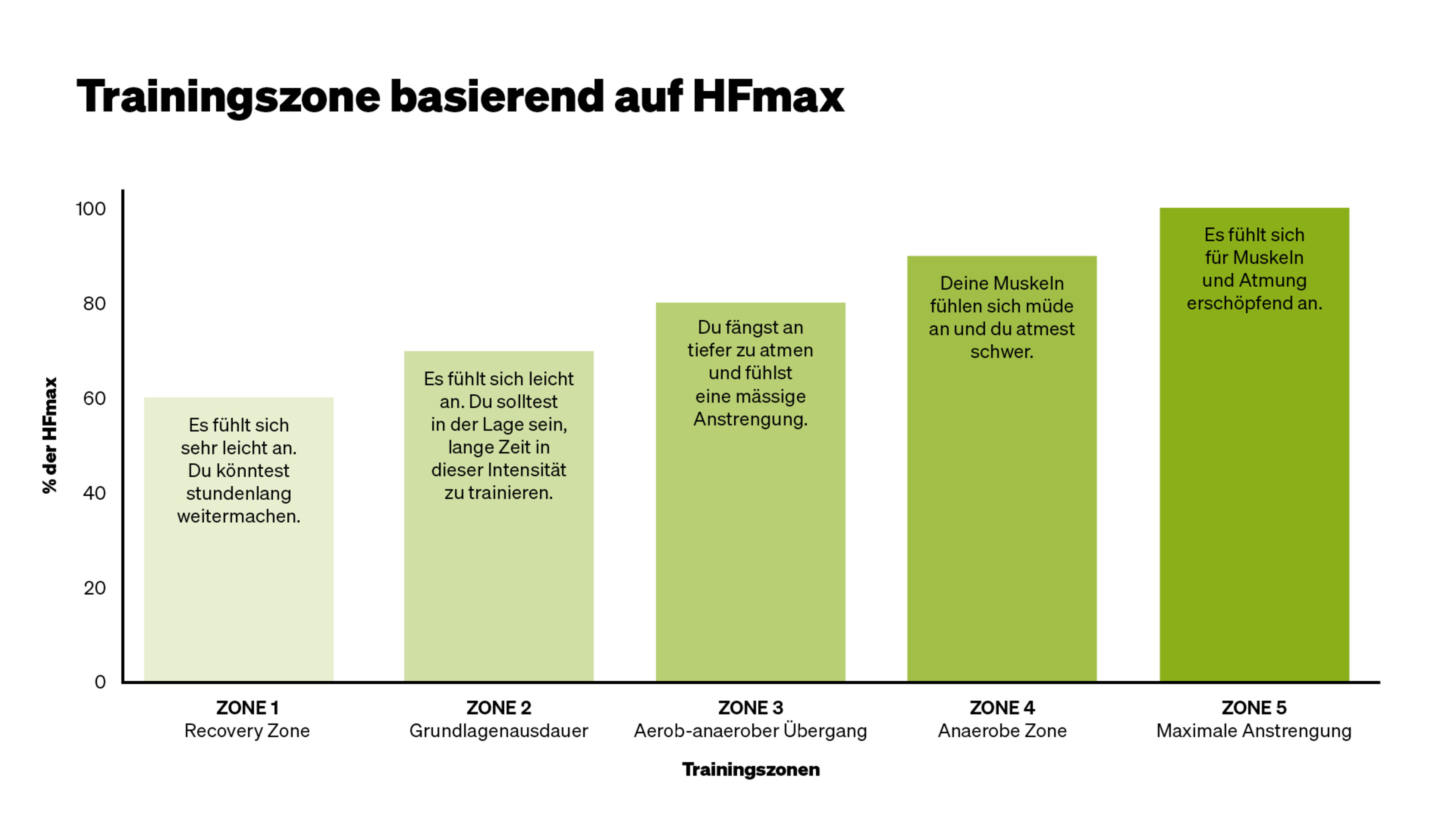
For recreational athletes, dividing training into five zones makes sense
Zone one is for recovery; at this intensity, you should still be able to hold a conversation without any trouble during your workout. Zone two, in particular—the foundation of your endurance—is often underestimated, even though it enables significant progress. In contrast, more intense intervals in the higher zones significantly boost performance and are common components of an ambitious training plan.


Zone 1 Training
Recovery Zone (50–60% of HRmax)
Zone 1 is the easiest training zone and is used for active recovery. The intensity is low, breathing is calm, and you can easily hold a conversation. Training in this zone promotes blood circulation, supports muscle recovery, and helps relieve tension. Typical activities include light jogging, walking, or relaxed cycling. Zone 1 training is especially important after intense workouts to optimize recovery and prevent long-term overexertion.
Recovery Tools from BLACKROLL
Standard
Available in multiple variants


Calculate Zone 2 and Training
Basic Endurance (60–70% of HRmax)
Zone 2 is one of the most important training zones, especially for endurance athletes, as it improves aerobic capacity and optimizes fat metabolism. In this zone, the body works efficiently and primarily uses fat as an energy source. Training in Zone 2 strengthens the cardiovascular system, increases capillary formation, and improves oxygen delivery to the muscles. It lays the foundation for sustainable performance gains and optimally prepares the body for higher levels of exertion.
Characteristics of Zone 2 Training
- Intensity: Moderate, with calm, controlled breathing. You can still hold a conversation.
- Typical duration: 30 minutes to several hours, depending on the training goal.
- Recommended activities: Slow endurance runs, cycling, walking, or easy swimming.
Calculating Zone 2
The intensity in Zone 2 is determined based on your maximum heart rate (HRmax) or your individual exercise pace. To calculate your heart rate for Zone 2:
1. Determine your HRmax:
- Performance testing (precise method)
- Or rule of thumb: HRmax = 220 - age
2. Calculate 60–70% of your HRmax :
- Example: You are 30 years old; your estimated HRmax is:
220 - 30 = 190 bpm (beats per minute)
Zone 2 is then: - 60%: 190 × 0.60 = 114 bpm
- 70%: 190 × 0.70 = 133 bpm
Your Zone 2 heart rate is therefore 114–133 bpm.
Benefits of Zone 2 Training
- Improved aerobic capacity and endurance.
- Optimizes fat metabolism, ideal for longer workouts.
- Lays the foundation for training at higher intensity levels.
- Reduced risk of injury due to low impact.
Regular training in Zone 2 is essential for anyone who wants to build or maintain their endurance and overall fitness.
Zone 2 Running—What Are the Benefits?
The basic endurance pace is the running speed maintained in Zone 2 (60–70% of HRmax), which aims to improve aerobic fitness and optimize fat metabolism. This pace is individual and depends on your fitness level, but it should always be within the range of a moderate pace where you feel comfortable and can hold a conversation.
Endurance plays a crucial role in running, and this is exactly where Zone 2 running comes in. This heart rate zone, often referred to as the “aerobic zone,” typically ranges from 60–70% of your maximum heart rate. Running in this zone boosts the efficiency of your cardiovascular system by improving your muscles’ ability to utilize oxygen. This helps you build endurance for long-distance runs, which is especially important for longer runs.
Metabolic Adaptation
A frequently underestimated benefit of Zone 2 workouts is metabolic adaptation. By training regularly in this zone, you train your body to use fat as its primary energy source, which increases your overall energy efficiency. At the same time, you reduce the risk of overtraining, since Zone 2 runs are less intense and therefore place less stress on your joints and muscles.
When combined effectively with more intense sessions, these runs can build a solid foundation that allows you to train more effectively in other training zones. So make sure to set aside enough time for Zone 2 sessions, and vary your route selection to avoid boredom and stay motivated.
The goal is consistency and regular training so you can reap the long-term benefits.


Aerobic Zone
In the aerobic zone, the body operates at a moderate intensity. Here, energy is primarily supplied by oxygen, and carbohydrates and fats are the main energy sources.
This training phase is particularly suitable for improving cardiovascular endurance and increasing overall performance over longer periods of time.
Training in the aerobic zone strengthens the heart and promotes capillary development in the muscles, which increases oxygen efficiency. This zone is crucial for building a solid foundation of endurance, which is essential for athletic activities. The heart rate typically ranges between 60% and 75% of the maximum heart rate, allowing you to train at a pace that feels comfortable to moderate.
A practical tip: Start with 20- to 30-minute sessions and gradually increase the duration to build endurance without raising the risk of injury. A smart training program strikes the right balance between training stimulus and recovery to achieve the desired physiological adaptations.
Incorporate regular workouts in this intensity range into your program to lay the foundation for higher-intensity training zones. This not only leads to physiological improvements but also fosters the mental resilience needed to successfully complete extensive training programs.


Zone 3 Training
Aerobic-Anaerobic Transition (70–80% of HRmax)
Zone 3 lies between aerobic and anaerobic energy production. In this zone, the body begins to use more carbohydrates as an energy source as the intensity of the workout increases and oxygen demand rises. It is ideal for raising the lactate threshold and improving tempo endurance, which is particularly important for ambitious recreational and competitive athletes.
Characteristics of Zone 3 Training
- Intensity: Strenuous but controlled. Conversation is only possible to a limited extent.
- Feeling: You notice that you’re moving out of your comfort zone, but without becoming completely exhausted.
- Typical duration: 15–60 minutes, depending on your training goal and fitness level.
- Recommended sessions: Tempo runs, brisk endurance runs, or longer intervals.
Benefits of Zone 3 Training
- Improved lactate threshold: You’ll learn to run longer at higher intensities before fatigue sets in.
- Increased pace endurance: Perfect for runners who want to maintain their speed over longer distances.
- Cardiovascular fitness: Your heart and lungs work more efficiently and supply your muscles with oxygen more effectively.
- Race preparation: Zone 3 is an effective training zone for practicing specific race paces.
Note:
Zone 3 is often referred to as the “gray zone” because it is more intense than base training (Zone 2) but less specific than high-intensity training (Zone 4). It should therefore be specifically integrated into your training plan to avoid overtraining.


Zone 4 Training
Anaerobic Zone (80–90% of HRmax)
Zone 4 marks the transition to intense anaerobic exercise, during which the body primarily uses carbohydrates as an energy source and produces more lactate than can be broken down. This type of training improves maximum performance and lactate tolerance. It is ideal for athletes who want to increase their speed and endurance at high intensities.
Characteristics of Zone 4 Training
- Intensity: Very strenuous; brief conversations are barely possible.
- Feeling: Highly demanding, bordering on exhaustion, but still manageable.
- Typical duration: 2–8 minutes per interval, multiple repetitions with rest periods.
- Recommended sessions: Intervals, hill sprints, or race simulations.
Benefits of Zone 4 Training
- Improved lactate threshold: You can train at high intensities for longer before fatigue sets in.
- Increased anaerobic capacity: Your body learns to handle lactate efficiently.
- Enhanced competition performance: Particularly useful for short- to medium-distance events.
Due to the high intensity, Zone 4 should not appear too often on your training plan—ideally 1–2 times per week.


Training in Zone 5
Maximum effort (90–100% of HRmax)
Zone 5 is the most intense training zone and is used to develop maximum oxygen uptake (VO2max), sprint power, and explosiveness. The body works almost exclusively anaerobically, and the intensity can only be sustained for a very short time.
Characteristics of Zone 5 Training
- Intensity: Maximum effort; breathing is extremely difficult; conversation is impossible.
- Feeling: Full effort, on the verge of complete exhaustion.
- Typical duration: 10 seconds to 2 minutes per interval, with longer rest periods between repetitions.
- Recommended exercises: Sprints, high-intensity intervals (HIIT), race finishes.
Benefits of Zone 5 Training
- Increased VO2max: Your body improves its oxygen uptake and utilization.
- Increased explosive power: Ideal for sprints, explosive movements, and final sprints.
- Physical and mental resilience: You learn to cope with maximum exertion.
Zone 5 is extremely demanding, so approach it with caution to avoid overexertion and injuries.


Specifically for Runners – Running Zones
For runners, training zones are essential for optimally managing running training and achieving long-term progress. Specific running zones are usually based on heart rate or running pace and are tailored to individual performance parameters. They help target different physiological systems and manage the intensity of training in line with your goals.
An Overview of the 5 Running Zones
Zone 1: Recovery Zone (50–60% of HRmax)
- Goal: Recovery, promoting blood circulation, active recovery between intense sessions.
- Pace: Very slow, relaxed running at a pace where you can easily hold a conversation.
- Benefits for Runners: Reduces muscle fatigue and promotes recovery after hard workouts.
Zone 2: Aerobic Base (60–70% of HRmax)
- Goal: Build basic endurance and improve fat metabolism.
- Pace: Slow endurance run at a pace that allows you to maintain a steady breathing rhythm.
- Benefits for runners: Essential for marathon training and long-distance running.
Zone 3: Aerobic-Anaerobic Transition (70–80% of HRmax)
- Goal: To raise the lactate threshold and improve tempo endurance.
- Pace: Moderate to fast, strenuous but without complete exhaustion.
- Benefits for runners: Ideal for interval or tempo runs to help you get used to maintaining a higher pace for longer periods.
Zone 4: Anaerobic Zone (80–90% of HRmax)
- Goal: To increase maximum performance capacity and lactate tolerance.
- Pace: Very fast, close to race pace for short distances.
- Benefits for runners: Perfect for short intervals or training for middle-distance races.
Zone 5: Maximum Effort (90–100% of HRmax)
- Goal: To maximize sprint speed and VO2max.
- Pace: All-out, maximum effort for a very short duration (30 seconds to 2 minutes).
- Benefits for runners: For sprints, high-intensity interval training (HIIT), and race preparation.
How to Determine Your Running Zones
Heart Rate Measurement:
Determine your maximum heart rate (HRmax) using a performance test or the rule of thumb:
HRmax = 220 - age (this calculation isn’t very accurate, but it’s a good guideline). Use these values to calculate the percentage zones.
Running Pace:
Based on your race times (e.g., a 10-km run), you can define pace-based zones.
Example: Zone 2 corresponds to 70–80% of your 10-km race pace.
Feeling:
Some runners train intuitively by gauging intensity based on their effort and breathing. This method is particularly suitable for experienced runners.
Integrating Zones into Your Running Training
A balanced training plan for runners should include sessions in different running zones to improve both endurance and speed. For example, long runs in Zone 2 could be combined with intense intervals in Zone 4 to boost overall performance.
Fitness trackers and gadgets for determining your training zones
Modern fitness trackers and sports watches offer an easy way to precisely determine your training zones and keep track of them during your workout. These devices typically use heart rate measurements, GPS data, or performance metrics to provide real-time feedback and optimize your training.
How Do Fitness Trackers Work?
- Heart Rate Monitoring:
Fitness trackers measure heart rate either via optical sensors on the wrist or via more accurate chest straps. Training zones are calculated based on your maximum heart rate and displayed during your activity.
- Performance data:
Some devices, such as those designed for cyclists or runners, use power meters to calculate intensity based on the power output. This allows for even more precise control, regardless of heart rate fluctuations.
- GPS and motion sensors:
Trackers use GPS data and motion analysis to monitor pace, distance, and intensity, allowing them to define specific zones based on your pace or speed.
Which devices are particularly suitable?
1. All-around sports watches:
- Garmin, Polar, Suunto: Offer detailed heart rate zones, customization, and advanced training analytics.
- Apple Watch: Combines fitness tracking with everyday usability and automatically detects training zones.
2. Chest straps:
- Polar H10, Garmin HRM: Ideal for precise heart rate measurements, especially during high-intensity intervals.
3. Specialized gadgets:
- Whoop: Monitors recovery and stress levels to tailor your training to your body’s condition.
- Stryd Running Power Meter: Measures running performance and enables training intensity control based on specific training zones.
Benefits of Fitness Trackers for Training Zones
- Easy Control: Trackers provide feedback on whether you’re training in the right zone.
- Personalized Data: Many devices offer tests to determine your HRmax, VO2max, or lactate threshold.
- Analysis: After your workout, you can analyze your performance and see how much time you spent in each zone.
With the right combination of a fitness tracker and personalized data, you can make the most of your training zones and make your workouts more efficient.


Conclusion: How to Get the Most Out of Training Zones
Training within the right training zones is the key to an effective and goal-oriented training plan.
Each zone serves a specific purpose—from recovery and building basic endurance to increasing your maximum performance capacity. By determining your individual training zones and using them strategically, you can efficiently improve your fitness, avoid overtraining, and optimally prepare for your athletic goals.
The combination of moderate training in Zone 2 to build a solid foundation, intense sessions in Zone 4, and occasional peak efforts in Zone 5 maximizes your progress without overloading your body. Support your training with fitness trackers or performance diagnostics to precisely monitor your zones and get the most out of every run, bike ride, or workout.
Train according to a plan, stay disciplined, and make sure to give your body the recovery time it needs. This way, you can reap the long-term benefits of training zones and achieve your athletic goals safely and effectively.