




Fascia & Self-Massage4 min read
Fascial Stretch: How It Works and What It Does

Claudio TrentoExpert in Muscle Length Training and Pain Coach
Fascia is a highly diverse tissue that fulfills many functions and is composed of numerous components. To keep our fascia supple as a whole, we need a variety of movement stimuli.
Static stretching allows us to target some of the fascia, but not all of it. With fascial stretching, on the other hand, we stretch our fascia in all directions, aligning our connective tissue fibers in a scissor-like grid pattern and thereby creating balance in the body.
Find out below what fascial stretching entails, how it differs from traditional stretching, and what benefits it offers you.
01
What is fascial stretching?
When you stretch out in bed in the morning before getting up and stretch as far as you can, you’re already getting very close to the idea of fascial stretching. It’s a new type of stretching that’s actually not just stretching, but also strengthening and mobilization.
It focuses on muscle-fascia chains rather than isolated individual muscle segments. The long muscle chains are stretched in all directions to their end positions and placed under tensile stress.
Think of it this way: You assume a stretching position and, at the same time, try to stretch yourself in multiple directions and become more expansive. The goal of fascial stretching is to arrange the collagen fibers (a component of our fascia) into a scissor-grid-like network. We achieve this through multidirectional stretching impulses, such as those used in fascial stretching.
02
What is the difference between fascial stretching and traditional stretching?
The goal of fascial stretching is to make your tissue more elastic and, at the same time, more stable. Fascial stretching is gentle and rhythmic. The movements aren’t jerky, but rather light and playful. From the outside, it looks like movements in a flow. You sort of rock into the position. So it’s not a static, long-held stretch, but an active one where you first build up tension and lengthen your muscles. Tension and pull are introduced as you allow yourself to melt into the respective position. The biggest difference between fascial stretching exercises and conventional stretching lies in the change in vectors: the fascia really benefits when it is pulled and stretched in all possible directions around the joints.
Why? The background lies in the structural principle of tensegrity. The understanding of fascia as flabby connective tissue with no specific function has completely changed. It is now scientifically proven that fascia forms a fine-meshed network that envelops and permeates all muscles, bones, and organs. Ideally, this tissue is elastic; it absorbs water like a sponge. At the same time, it provides stability. Fascia researchers are certain that it is not the bony skeleton that keeps the body upright, but rather that all the bones would collapse in on themselves if the fascia failed to function as a supporting structure.

Fascial Stretch

Classic Stretching

Fascia Stretching Exercises
Stretching Your Fascia: Exercises with the BLACKROLL®03 What happens if you don’t stretch?
If fascial structures aren’t used or are subjected to one-sided strain—for example, by sitting for long periods or using only your right hand—the tissue is no longer optimally hydrated, and nutrients can no longer reach all areas. The tissue crystallizes, much like thin honey that hardens. You’ll notice this because you’ll feel less flexible and stiffer overall, and you may even experience pain in certain areas. The fasciae have become stuck together. Colloquially, this is often referred to as “shortening.”
04 What are the effects of fascial stretching?
When you stretch in this specific way, you particularly stimulate the mechanical functions of the fascia: waste products are broken down, adhesions are released, and your tissue becomes more supple. This makes sense as a warm-up before exercise, but also for pain relief when you’re experiencing discomfort. The more you can integrate the entire muscle-fascia chain, the greater the effects.
Through the long-chain, three-dimensional stretching in the Fascial Stretch
- , you create space again within the joint surfaces.
- boost your metabolism.
- promote recovery.
- become more flexible overall
- and bring suppleness to your body.

05
Fascial Stretch & the Phenomenon of Pandiculation
Pandiculation—or, colloquially, “stretching like a cat”—is easiest to understand when you watch a pet waking up from a nap and getting ready to stand up. It’s the technical term for a specific type of stretching, licking, and stretching out, as seen in animals. A big cat or a domestic dog extends its body, actively lengthening itself from the inside. In doing so, it also actively pushes its paws against the ground, which automatically results in a counter-extension of the torso and hind legs. The Downward-Facing Dog pose in yoga comes very close to this position.

Alternating Cat-and-Cow: From a tabletop position, round your upper back. Segment by segment, starting with the thoracic spine and looking toward your navel.

Cow: Move in the opposite direction, arching the spine into a hollow back, also segment by segment.

Deep squat (sitting on heels); the superficial back line is stretched. Lift the sternum and lengthen the spine.
How can I get started with fascial stretching?
To get started with fascial stretching, here are some simple steps you can follow:
1. Basic Understanding
Fascial stretching is different from traditional static stretching. Fascial stretching involves performing gentle, dynamic movements that stretch your fascia in multiple directions. The goal is to mobilize the connective tissue and release adhesions to promote elasticity and flexibility.
2. Start with Simple Exercises
Start with basic exercises that target large muscle chains.
Some simple beginner exercises include:
Cat-Cow Pose: From a tabletop position, round your back and then arch it into a hollow back. This exercise helps stretch your fascia along the spine.
Downward-Facing Dog: This yoga pose stretches your entire back, from your shoulders to your legs, and promotes blood circulation.
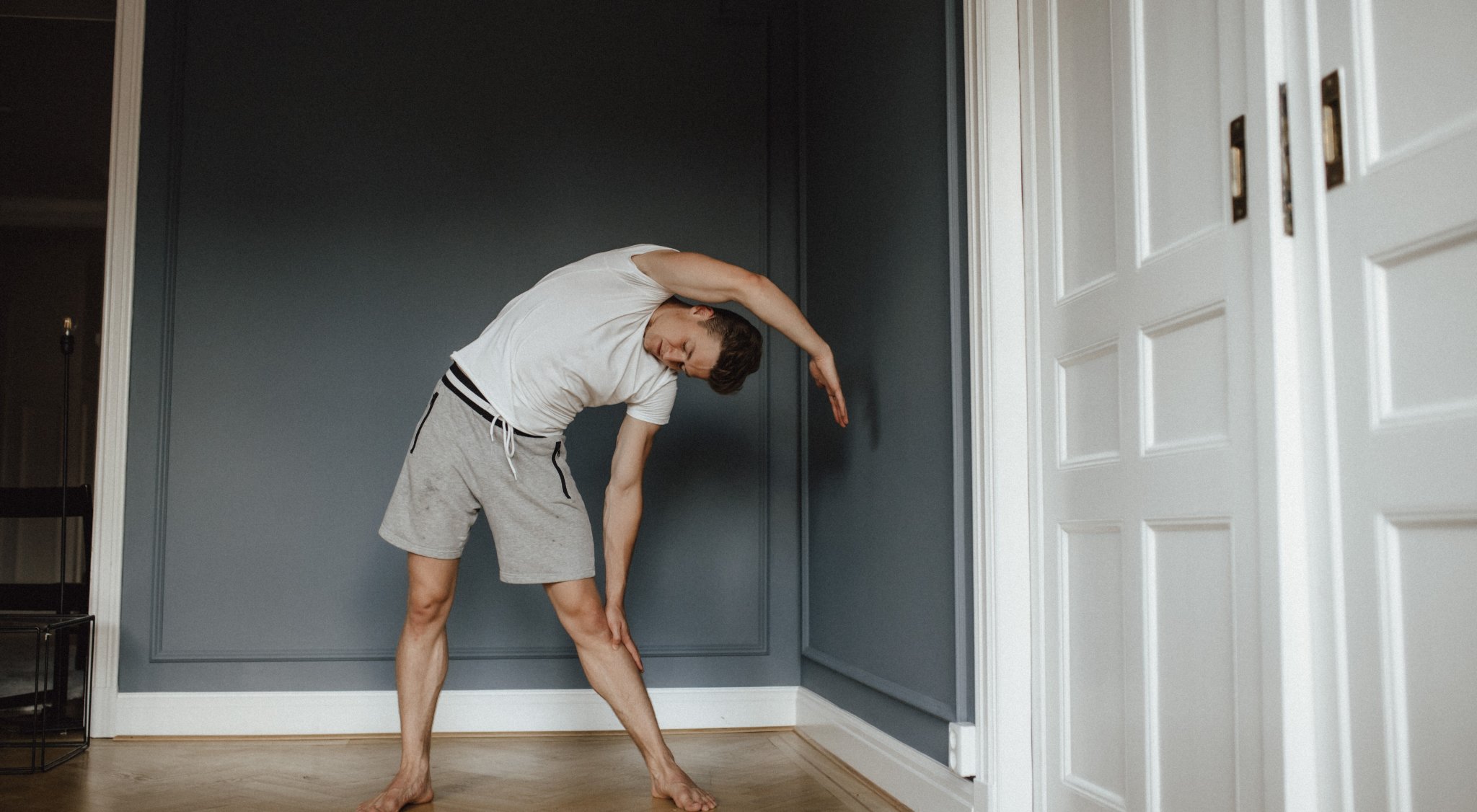
Standing Side Stretch: Stand upright, reach one hand over your head, and gently lean to the side. Switch sides. This exercise stretches the lateral fascia chains.
3. Move playfully
Unlike static stretching, it’s important to make flowing and dynamic movements during fascial stretching. Instead of holding a position rigidly, you should melt into the stretch and gently sway or rock. This stimulates the elasticity of the fascia.
4. Breathe deeply and evenly
Deep, steady breathing helps intensify the stretch while releasing tension. Breathe calmly into the stretched areas to better release the tension.
5. Use props
You can also use props such as a foam roller or a ball to target specific areas. These tools help release tight fascia and stimulate blood flow.
6. Consistency is key
Fascia stretching is most effective when done regularly. Often, investing just a few minutes in this practice 2–3 times a week is enough.
Scientific Basis and Benefits of Fascial Stretching
Fascial stretching is based on scientifically sound findings that show that connective tissue—known as fascia—plays a central role in mobility, stability, and pain relief. Research by Dr. Robert Schleip and other experts has demonstrated that fascia forms an elastic network within the body that is stimulated and kept supple through dynamic, multidirectional stretching movements.
This type of stretching enhances the mechanical and sensory properties of the fascia, helps break down adhesions, and contributes to improved mobility and posture. Studies have also shown that fascial training is based on the principle of **tensegrity**, which promotes structural balance in the body. Regular fascial stretching can not only improve flexibility but also help alleviate chronic pain.
Sources:
- Schleip, R., et al. (2006). "Fascial plasticity – a new neurobiological explanation: Part 1." *Journal of Bodywork and Movement Therapies*.
- Ingber, D. E. (2008). "Tensegrity-based mechanosensing from macro to micro." *Progress in Biophysics and Molecular Biology*.
- Findley, T. W., Shalwala, M. (2013). "Fascia Research Congress: Evidence from the 100-Year Perspective of Andrew Taylor Still." *Journal of Bodywork and Movement Therapies*.
- Yahia, L. H., Pigeon, P., DesRosiers, E. A. (1993). "Viscoelastic properties of the human lumbodorsal fascia." *Journal of Biomedical Engineering*.
- Schleip, R., Müller, D. G. (2013). "Training principles for fascial connective tissues: Scientific foundation and suggested practical applications." *Journal of Bodywork and Movement Therapies*.
- Langevin, H. M., Sherman, K. J. (2007). "Pathophysiological model for chronic low back pain integrating connective tissue and nervous system mechanisms." *Medical Hypotheses*.